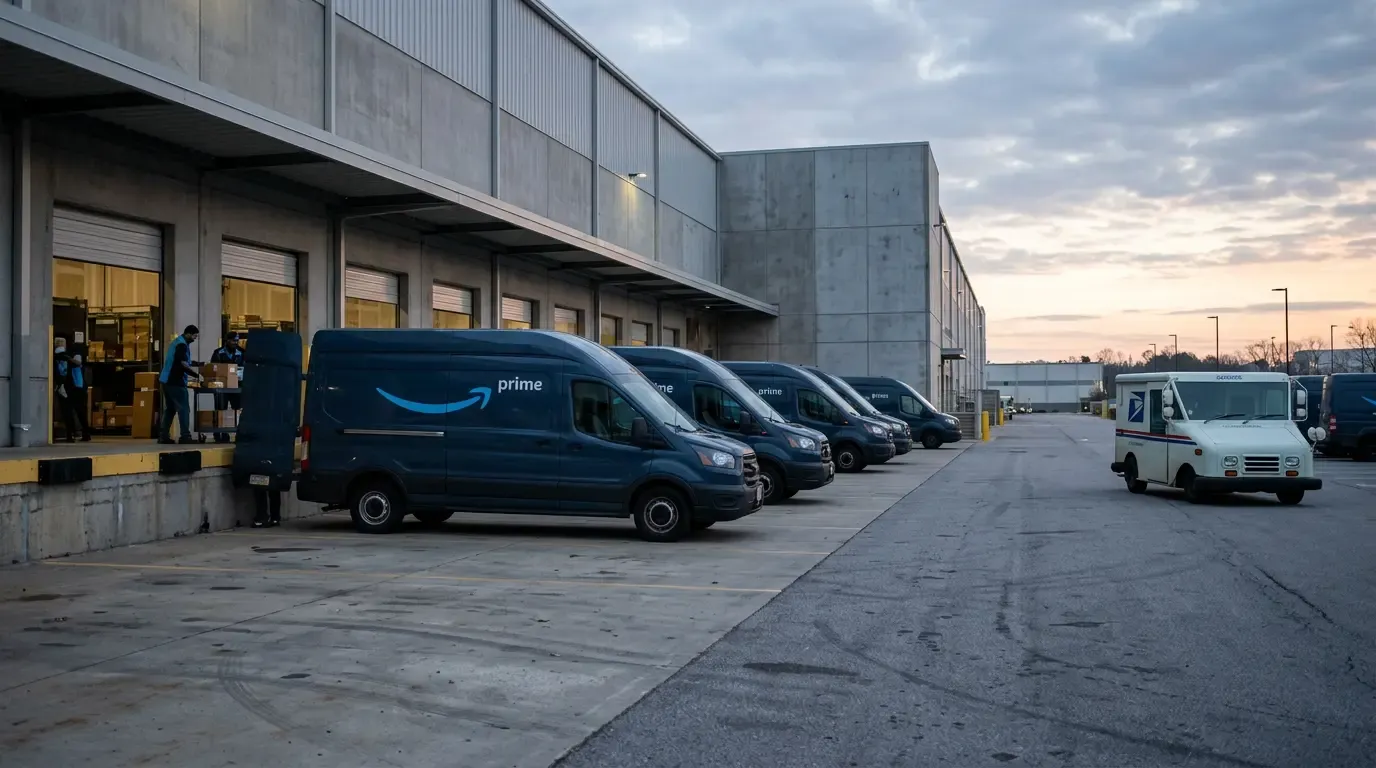
Amazon has nearly matched USPS in delivery volume and is already named the largest parcel carrier by some publications. Discrepancies arise from different data sets and accounting periods used by research firms, while the market becomes less transparent due to retailers' internal networks and regional operators.
In the FreightWaves article referencing ShipMatrix data, it is stated that by the end of 2025, Amazon Logistics delivered 6.7 billion parcels, surpassing USPS (6.6 billion). The same estimate indicates that the total market volume was 23.9 billion shipments (a mere 0.4% year-over-year growth), meaning the redistribution of shares occurred mainly within an almost "flat" market. ShipMatrix also notes significant growth in "alternative" carriers — 2.6 billion parcels (+13%), highlighting the accelerating fragmentation of the last-mile segment.
Meanwhile, data from another widely cited source — Pitney Bowes — presents a different picture for the last fully published year. In a Digital Commerce 360 review referencing the 2024 Parcel Shipping Index, it is noted that in 2024, USPS remained the largest carrier by volume: 6.9 billion parcels (31% of the market) compared to Amazon's 6.3 billion (28%). In this logic, Pitney Bowes describes the "convergence" of Amazon and USPS as a trend that should lead to a change in leadership later. A similar thesis that Amazon might surpass USPS by 2028 is mentioned in a Supply Chain Dive summary, also based on Pitney Bowes calculations.
Regardless of the discrepancies in the "overtake" timing in the rankings by units, both data lines agree on the main point: Amazon is rapidly increasing its share, relying on its own last-mile infrastructure and expanding work not only with shipments related to its marketplace. For the market, this means a further shift in the traditional balance between the "big three" and the internal networks of major sellers, as well as the growing role of regional and niche players where federal and national networks optimize delivery economics.
ShipMatrix, as presented by FreightWaves, specifically points out a shift in UPS and FedEx strategies: they are moving away from some "commoditized" B2C last-mile deliveries in favor of more profitable areas — B2B and more complex e-commerce shipments with better margins. In ShipMatrix figures, this looks like a decrease in UPS volume to 4.4 billion parcels (-8.3% year-over-year) while FedEx grows to 3.6 billion (+5.9%). USPS also showed an 8.3% decrease in this estimate, highlighting the pressure on traditional networks in the mass segment.
Stay Updated with Industry News
Subscribe to our newsletter and get the latest trucking industry news, regulations updates, and career tips delivered to your inbox.
We respect your privacy. Unsubscribe at any time.
Simultaneously, ShipMatrix describes how the "physical" characteristics of the flow are changing: delivery distances are shortening as inventories move closer to the customer, restructuring the economics of zoning and transportation legs. Specifically, the article notes that USPS Parcel Select typically travels less than 150 miles. For operators who traditionally built their model on interregional movements to sorting hubs and further delivery, such a shift means different requirements for network density, the number of local facilities, and capacity management.
Another marker of redistribution is the difference between leadership by volume and leadership by revenue. According to ShipMatrix data cited by FreightWaves, the parcel market in 2025 was valued at $196 billion (+4.1%), and the average revenue per parcel increased to $8.20 (from $8.00 the previous year). Meanwhile, ShipMatrix attributes the highest revenue among carriers to UPS — $58.3 billion, followed by FedEx — $57.1 billion, Amazon Logistics — $38.5 billion, and USPS — $32.5 billion. This configuration shows that even with the growth in unit volume at Amazon, the tariff structure, service mix, and share of more expensive services still significantly influence the financial standings.
A separate note in the FreightWaves article mentions that FedEx has resumed some deliveries for Amazon in specific scenarios: this involved resuming work with larger and more complex shipments for "door-to-door" delivery after severing ties in 2019. This episode fits into a broader trend: major networks strive to select segments where service demands and operational complexity convert into higher profitability, rather than racing for the maximum number of low-cost parcels.
For carriers and shippers, the practical side of the news is that the market's "fulcrum" is gradually shifting: a portion of the volume increasingly passes through the internal logistics circuits of major sellers, while in the "long tail," independent and regional operators are growing. ShipMatrix, according to FreightWaves, directly records the acceleration of this segment, whereas Pitney Bowes, as presented by Digital Commerce 360 and Supply Chain Dive, emphasizes Amazon's proximity to USPS in volume and the expected change in leadership at later dates. The difference in timing does not negate the fact: the gap between the two largest parcel players has significantly narrowed compared to previous periods, and the dynamics of shares are increasingly determined by how quickly companies expand their own last mile and redistribute flows between partners and internal capacities.