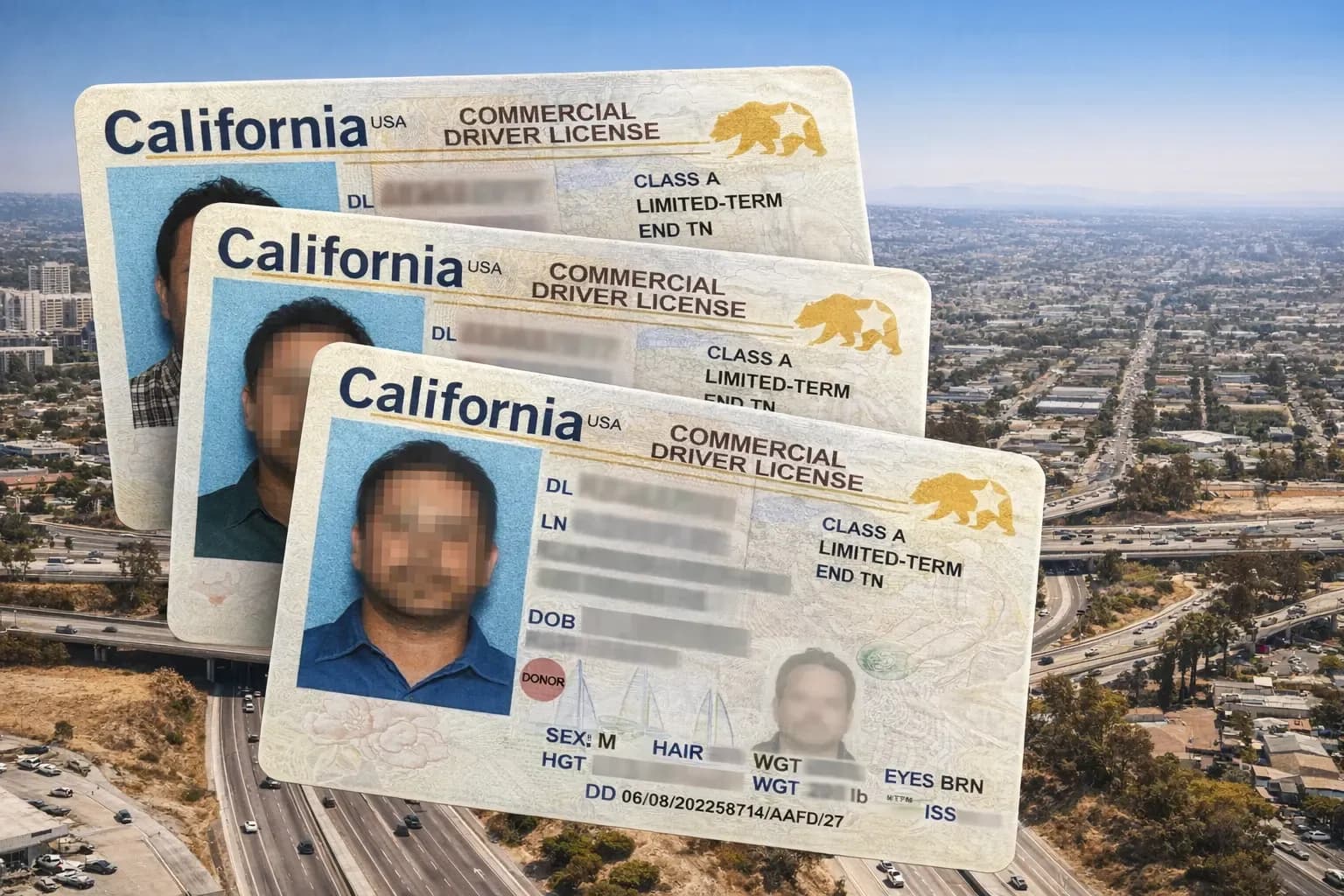
A California Supreme Court judge in Alameda County issued a preliminary (tentative) ruling temporarily blocking the state's actions to revoke commercial driver's licenses (CDL) from some immigrants with so-called non-domiciled licenses. Practically, this means drivers affected by the cancellation campaign can continue working—at least until the court's final decision and further process developments.
The case arose from a lawsuit challenging the California DMV's attempt to start mass license revocations for drivers deemed non-compliant with updated federal requirements. According to a USA TODAY publication, it involves over 17,000 drivers in California targeted for CDL revocation since November 2025.
For the freight market, this isn't an abstract immigration discussion. In California, any sharp drop in drivers quickly translates into disruptions in "short-haul" (port drayage, regional delivery, construction, agriculture), followed by rate spikes and missed delivery windows. The court has effectively "frozen" the scenario of an immediate workforce reduction, but uncertainty remains: the decision is temporary, and the federal agenda continues to advance.
The core issue is the procedure and consequences of revoking CDLs from "non-domiciled" license holders. These licenses are issued to drivers who aren't state residents in the traditional sense and have long been used in sectors with historically higher immigrant representation.
Plaintiffs—advocacy groups including the Asian Law Caucus and Sikh Coalition—challenge the DMV's actions, arguing the state pursued license "nullification" without sufficient safeguards and proper procedure. Media reports highlight the argument that drivers weren't provided a correct and predictable mechanism to retain their work rights: for instance, reissuing documents, correcting expiration dates, undergoing required checks, or obtaining "cancel without prejudice" with the option for quick reapplication.
Stay Updated with Industry News
Subscribe to our newsletter and get the latest trucking industry news, regulations updates, and career tips delivered to your inbox.
We respect your privacy. Unsubscribe at any time.
For employers and brokers, the practical impact is equally tangible: when a driver's CDL status becomes a legal issue, any plans for shifts, port slots, tractor/chassis reservations, and contract KPI fulfillment hinge on temporary solutions. Especially if drivers are assigned to specific clients and routes rather than "floating" across the network.
The California case unfolds against a broader federal DOT/FMCSA trend toward "cleaning up" the non-domiciled CDL segment. Industry reviews indicate that in 2026, FMCSA is handling a significant package of changes and initiatives, including efforts explicitly described as removing non-domiciled drivers from roads to enhance compliance and address system admission and training violations. This is mentioned in the 2026 FMCSA rule change overview published by industry consultant CNS Protects.
It's important to distinguish two layers: federal requirements for CDL issuance/maintenance integrity and specific state actions to revoke already issued documents. The Alameda court halted the "state" executive block (essentially an attempt to simultaneously remove thousands of active drivers from the system). But it doesn't overturn the federal course or guarantee the DMV won't return to the procedure later—with a different legal framework or following a final decision.
Simultaneously, the story gained political momentum in Washington. In 2026, President Donald Trump publicly promoted the "Dalilah Law" idea—a federal measure to prohibit states from issuing CDLs to "illegal immigrants"—in his State of the Union address. Senator Jim Banks (Republican, Indiana) introduced a bill with the same name and announced the launch of the Truck Safety Tipline—a channel for reporting drivers deemed unsafe or non-compliant by informants.
Even without the law's enactment, the "tipline" logic changes the carrier's risk profile. In 2026, many companies already operate under heightened scrutiny: insurers are stricter on DQF, pre-employment screening, MVR, violation history, and ELD discipline. Adding an external complaint source that can "highlight" cases based on immigration status, language, documents, or CDL issuance location pushes toward more formalized hiring and documentation procedures—and increases the likelihood of sudden driver downtime "pending clarification."
Media summaries of the initiative suggest discussions include English-only test requirements and narrowing the pool of CDL applicants (U.S. citizens, permanent residents, and some visa categories). For the market, this is sensitive not only due to staffing. It's also about replacement speed: if a significant portion of drivers is sidelined, not everyone can "pick up" volumes, especially in segments with strict TWIC, port pass, shift work, and terminal knowledge requirements.
The figure "over 17,000" potentially affected drivers in one state is a level capable of shifting the power and demand balance. If even part of these drivers were forced to stop during proceedings, the first wave of impact would hit port drayage and short-haul around Los Angeles/Long Beach and Oakland, followed by regional dry van and flatbed operations, including construction and infrastructure projects.
California itself is a market with high compliance costs: CARB and local environmental rules, expensive insurance, high equipment ownership costs, and staffing. Against this backdrop, losing drivers isn't just about "covering trips." It's a direct driver of contract rate rejections, spot growth, increased detention/demurrage due to schedule disruptions and slot shifts.
A separate issue for 3PLs and shippers is planning. Many large shippers in 2025–2026 shifted focus from "lowest rate" to execution predictability and guaranteed carrier availability. Any regulatory scenario that can simultaneously reduce the driver pool in a key state hits this strategy and forces holding more expensive reserve capacity.
The court's preliminary decision is a pause, not a conclusion. In the coming days/weeks (depending on the procedural calendar), finalization of the court decision and further explanations from the parties on the potential consequences of continued revocations and available mechanisms for drivers are expected.
For now, businesses must operate under dual pressure: a state court dispute in the largest freight state and the ongoing federal push for non-domiciled CDL control, which, judging by the FMCSA's 2026 industry agenda, won't be limited to California alone.