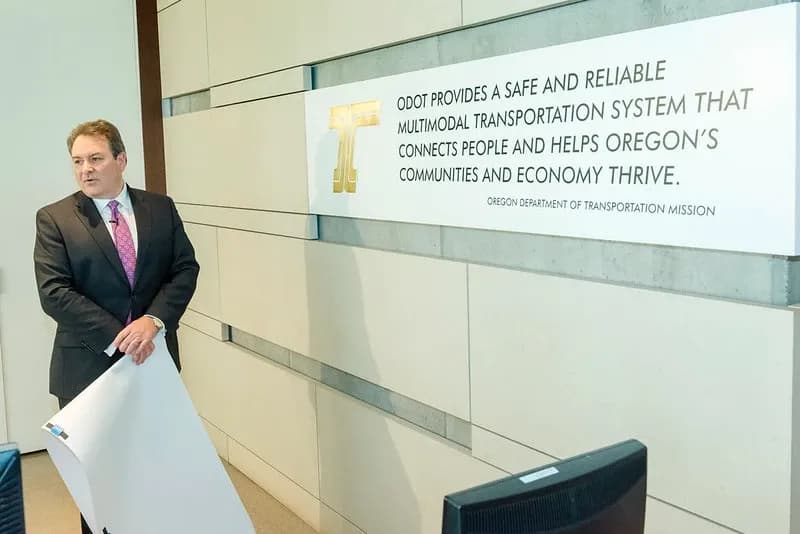
Oregon has officially confirmed the cessation of issuing non-domiciled commercial driver's licenses and learner's permits (CDL and CLP). The decision was approved on March 12, 2026, by the Oregon Transportation Commission, marking the final point in the limited-term issuance of such documents, which the state had already effectively put 'on pause' earlier.
According to information presented in the Transport Topics article, the initiative came from the leadership of the Driver and Motor Vehicle Services division within ODOT. DMV Administrator Amy Joyce, addressing the commission, directly linked the need to end the program with the risk of federal consequences: maintaining the practice deemed non-compliant by FMCSA could result in significant funding losses for the state. The publication estimates the potential risk for the 2027 fiscal year at $23.5 million, with possible increases in subsequent years.
The key trigger was the federal regulator's complaints about issuance procedures. FMCSA sent the state a notice of preliminary non-compliance on January 20, 2026. In correspondence referenced by Transport Topics, the regulator relied on the results of a selective audit: in 2025, FMCSA analyzed 1,426 active non-domiciled CLP/CDL issued by Oregon and noted a violation/error rate of about 13%. It was also noted that the issue was raised publicly: FMCSA Administrator Derek Barrs spoke about it at a press conference on February 20.
For the market, the operational consequences are most important, and here Oregon chose the strictest configuration. As described in Transport Topics, the state is ceasing all actions on limited-term documents: not only new issuances but also renewals, replacements, corrections, reissues, restorations, and other operations. This means that a driver with such a document, even if entitled to continue working until the expiration date, cannot obtain a duplicate if the card is lost and cannot 'fix' the document through regular procedures if data correction or replacement due to damage is needed. In the same logic, there is a ban on restoration after suspension, cancellation, or revocation.
Simultaneously, the state allows already issued licenses and permits to 'live out' until their expiration date, provided nothing happens to the document (revocation/suspension/cancellation/loss). According to Transport Topics, there are about 900 active holders of limited-term CDL/CLP in Oregon, with foreign drivers predominating among them. Meanwhile, ODOT's administrative rulemaking materials indicate that even before the final decision, DMV attempted to establish a transitional regime where issuance would be limited to existing holders, but the final federal framework turned out to be stricter than expected.
Stay Updated with Industry News
Subscribe to our newsletter and get the latest trucking industry news, regulations updates, and career tips delivered to your inbox.
We respect your privacy. Unsubscribe at any time.
State documents show that Oregon approached this decision step by step. On the ODOT page dedicated to rules and public discussions, it is described that DMV adopted an emergency rule on October 13, 2025, to halt the issuance of limited-term CLP/CDL in response to the federal 'interim final rule' effective September 29, 2025. Then DMV initiated a permanent rulemaking process, held virtual public hearings on February 18, 2026, and accepted comments until February 21; according to ODOT, four comments were received. In the ODOT bulletin via GovDelivery, it was emphasized that the initial idea—to allow extremely limited issuance only to those whose document was already valid on September 29, 2025—was supposed to be considered and approved on March 12, 2026, but the approach was revised considering the final federal rule effective March 16, 2026 (ODOT GovDelivery).
The final federal rule, on which the state relied, is described in Oregon's materials as a stricter set of requirements, including a direct ban on the reinstatement of limited-term documents. The ODOT page also lists specific changes in the state's administrative rules (OAR), which closed 'windows' for restoration after suspension/cancellation/revocation and clarified procedures for limited-term CDL/CLP, including the adoption of a separate provision directly aimed at preventing reinstatement (ODOT rules). This is an important detail for practice: even if the state had not announced a complete cessation of the program at the political decision level, the restrictions on restoration and narrow criteria for permissible issuance would have radically reduced the number of cases where the document could be maintained in an up-to-date state.
In the version of events outlined by Transport Topics, Oregon authorities simultaneously conducted a self-assessment and concluded that under the new federal criteria, 'only a very small number' of the approximately 900 existing holders of limited-term CDL/CLP would be able to meet the requirements when attempting renewal or replacement. The exact number was not specified by the state. As a result, the discussion shifted from 'how to maintain' issuance to how many resources would be needed to theoretically restart the program in full compliance: this includes the need for changes in state legislation, IT system modernization, and rewriting administrative procedures.
The context for the decision included similar actions in other jurisdictions: Transport Topics reminds that issuing non-domiciled CDL is not a mandatory option for states, although most provide it, and some have already abandoned it. Nevada is cited as a nearby example, where they previously announced the upcoming cancellation of nearly 1,000 such licenses after concluding non-compliance with FMCSA requirements. Ultimately, Oregon chose not to 'clean up' individual elements of the process but to close the entire issuance loop for limited-term CDL/CLP and allow existing documents only to work until the specified expiration date—without renewal and without service operations, which drivers and employers usually consider routine.