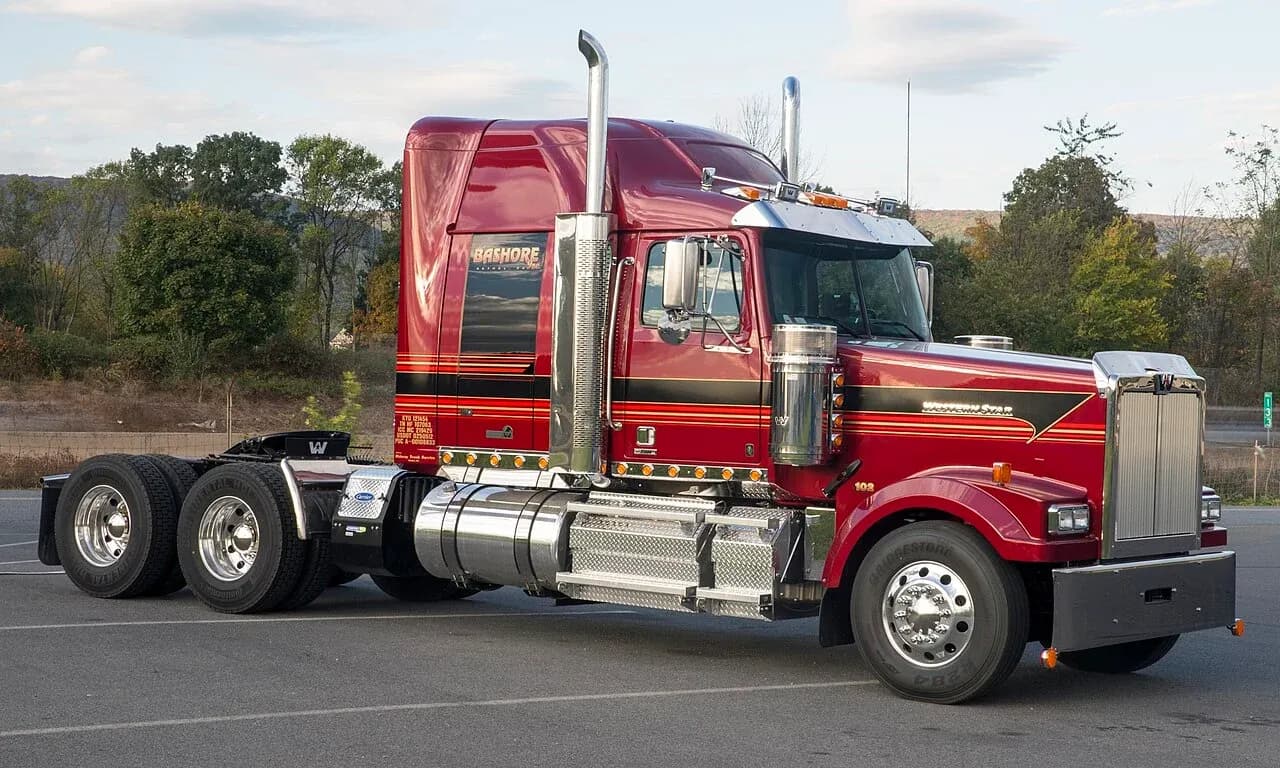
Daimler Truck North America (DTNA) announced the expansion and actual replacement of a previously launched service campaign for Western Star trucks due to the risk of a 'thermal event' in the area of the positive power connection on the frame. This concerns the positive stud at the power distribution point on the rail, through which the battery and/or auxiliary power distribution circuits are connected to the starter. Under certain conditions, the connection may degrade, leading to a short circuit, arcing, and potential fire.
The recall expansion resulted from the fact that the previous corrective measure, already performed on some vehicles, did not provide the required level of protection: the manufacturer received reports of corrosion and thermal incidents on trucks that had been repaired under the previous campaign. Details and parameters of the expanded recall are outlined in the NHTSA Recall Report for campaign 26V079: NHTSA document RCLRPT-26V079-0084.
According to the report materials, the expanded recall covers:
The range of model years and lineup is broad: Western Star 47X and 49X, including 47X model years 2021–2027 and 49X model years 2020–2027. The production range covers vehicles 'from the start of production' to February 3, 2026.
A key point for fleets: the population includes not only vehicles from the original recall but also some trucks from the 2026–2027 model years, assembled between May 14, 2025, and February 3, 2026, i.e., after the implementation of the 'updated' production/inspection process, which was intended as a barrier to prevent the problem from recurring. Nevertheless, as the materials indicate, even in this group, vulnerability to corrosion and related failures was identified.
Stay Updated with Industry News
Subscribe to our newsletter and get the latest trucking industry news, regulations updates, and career tips delivered to your inbox.
We respect your privacy. Unsubscribe at any time.
The total potential volume is 26,958 units. The estimated share of actually defective vehicles is about 1%, but for operation, this does not remove the issue: the failure scenario is fire-hazardous, meaning even isolated cases require the strictest reaction from the manufacturer and attentiveness from carriers.
The problem area is the power unit on the frame, where the positive stud serves as the connection/distribution point. According to the defect description, the stud may be improperly installed and/or exhibit increased susceptibility to corrosion. In practice, this means increased contact resistance, local heating, the possibility of arcing, and further development of a 'thermal event.'
For the fleet, this is not abstract electrics. The unit is located in an area where the real road environment works against durability: water, dirt, reagents, salt aerosol. In the 'salt belt' of the USA and in Canada, winter adds anti-icing chemicals, accelerating corrosion processes. On vehicles operating in regions with active road treatment, the risk of defect manifestation is logically higher—not because the defect 'spreads,' but because operating conditions bring the connection to a critical state faster.
The previous campaign (now expanded/replaced) involved a set of measures: adjusting the stud tightening torque, more consistent application of dielectric coating, and additional checks of cable terminal orientation. Similar approaches were implemented in production from late May 2025.
Then the 'fieldwork' began, which led to the expansion. DTNA received reports of corrosion and thermal events on trucks already repaired under the previous recall. The most notable episode in the materials is an incident in New York: on a repaired truck, corrosion led to arcing, resulting in a melted section of the frame, according to the description. This was followed by additional signals: another thermal incident, two cases with smoke, and corrosion-related failures identified during warranty claim analysis without 'thermal' development.
For the service market, this is an unpleasant 'rework' scenario: trucks that have already been brought to the dealer and formally closed under the previous campaign will have to be returned for a new solution. In reality, this means a second wave of dealer service load, repeated logistics for bringing the vehicle in for repair, and additional 'downtime' windows—especially sensitive for regional carriers with a small reserve of equipment.
The report materials feature an observation window from March 2023 to January 2026. During this period, DTNA attributes approximately 52 warranty claims and 18 field reports as potentially related to the problem.
At the same time, the manufacturer notes the absence of data on injuries and fatalities. For carriers, this is an important caveat, but it should not create a false sense of 'so we can wait': the fire risk in the power supply area is primarily a threat to the driver and others, then a risk of losing the tractor, trailer, cargo, and possible damage to infrastructure at loading/unloading sites.