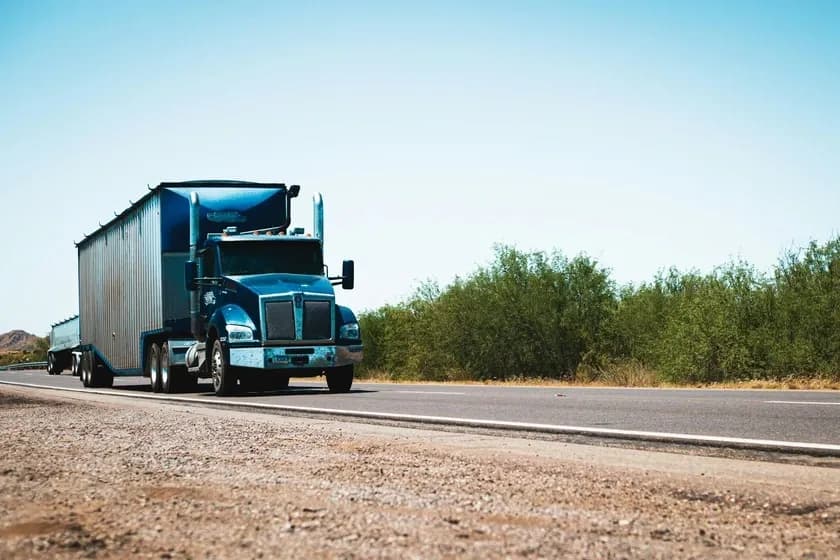
Aurora, developing autonomous driving technology for commercial transport, has begun driverless trips on the Phoenix (Arizona) to Fort Worth (Texas) route, spanning about 1000 miles. This is a significant step for the market: it's not about test 'circles' on closed tracks, but a regular linear route where transport economics rely on hours, tractor availability, and schedule predictability.
According to Aurora, its Aurora Driver system can operate not only on interstate highways but also on urban sections, formally claiming a broader operational scope than a 'pure highway.' This claim has already become a point of friction between technological promises and practical work at real loading and unloading points.
The Fort Worth-Phoenix route connects a major freight hub in North Texas with one of the key markets in the Southwestern USA. For operators, it's a typical corridor with heavy traffic, a high share of interstate sections, and a clear demand structure, where transit speed and ETA stability are valued.
Aurora claims that the autonomous mode allows nearly halving transit time compared to a driver-operated trip under hours-of-service rules. The logic is simple: a human crew is limited to 11 hours of driving and must take 10 hours of rest, which 'breaks' the continuity of the route over long distances. The autonomous system, according to the developer, does not require these pauses—meaning the tractor can maintain pace and traverse the corridor more linearly, with less dependence on shift schedules, driver availability, and client windows.
Another figure Aurora insists on is over 250,000 'driverless miles' since operations began in Texas last year, with the company claiming no accidents 'attributed' to its autonomous system. Importantly, there is no public verification of these figures from independent sources in available materials: additional searches found no regulator press releases or DOT/FMCSA reports specifically confirming these accumulated miles, incident accounting methodology, or responsibility outlines. For the professional market, this is not nitpicking over wording but a question of how to compare risk between autonomous and traditional routes and what events are considered a 'system' error of ADS versus external factors.
Stay Updated with Industry News
Subscribe to our newsletter and get the latest trucking industry news, regulations updates, and career tips delivered to your inbox.
We respect your privacy. Unsubscribe at any time.
Even without 'marketing magic,' reducing transit time on a long corridor has clear effects: the tractor turns around faster, it's easier to schedule under tight windows, there's a lower risk of missing a warehouse slot due to forced rest under HOS, and with a driver shortage, it's easier to maintain service levels.
The launch material includes a characteristic comment from the owner of a transport company specializing in car carriers: his position is generally supportive because, in the classic model, you have to 'build a business around driver rest.' This is an accurate formulation for any operator living by schedules, penalties for delays, and the constant conflict between delivery speed and compliance with labor standards.
However, autonomy does not negate the physics of the operation: the cargo still needs to be delivered on time, properly secured, documented, processed at the ramp, and queued at the port or DC. So the gain in transit may be partially 'eaten' by terminal bottlenecks. But on routes where the main cycle is linehaul on the highway, without complex urban delivery, the potential for acceleration and increased equipment utilization is indeed higher.
Aurora publicly sets a goal of more than 200 driverless trucks by the end of 2026. Against the backdrop of today's perception of any 'commercial' driverless operations in the US as still being unique, this target seems ambitious. But terminology is important here: for the market, it's crucial whether this will be a fleet performing regular transport on a stable schedule with clear KPIs, or an expanded pilot program with restrictions on weather, time of day, road set, and mandatory remote support.