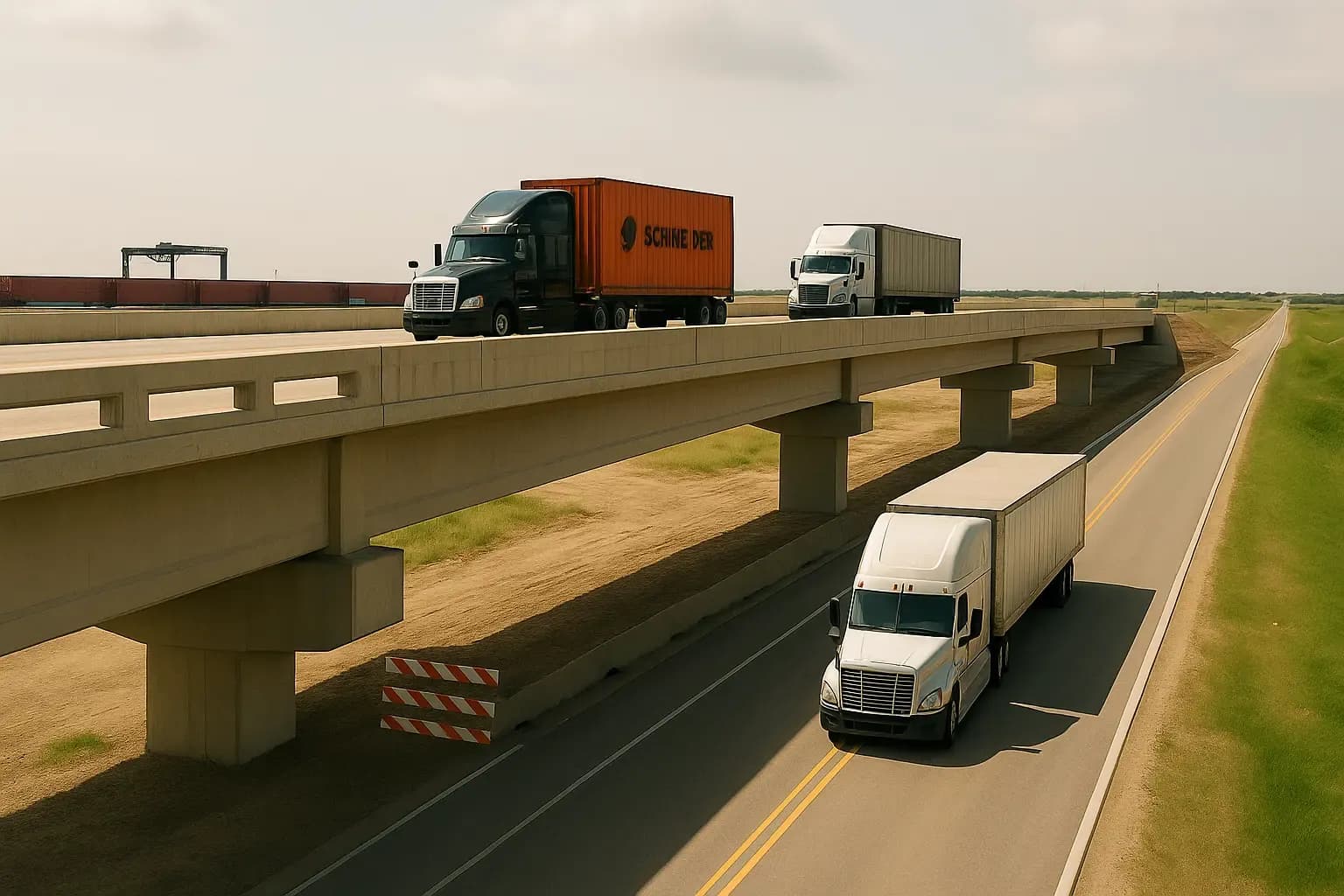
In the AllianceTexas logistics cluster in northern Fort Worth (Texas), an infrastructure project is underway that directly impacts the drayage and short-haul market: a private three-lane bridge, designed exclusively for heavy-duty truck traffic, will connect the BNSF intermodal terminal with nearby warehousing and distribution facilities. The project, costing around $20 million, is touted as a tool to alleviate public road congestion and speed up the 'last mile' from the rail hub to the warehouse gates, as well as being part of a broader 'autonomous-ready' freight corridor program.
Officially, the project is being promoted by developer Hillwood in collaboration with BNSF and the city of Fort Worth as part of the launch of the Alliance Logistics District — a special zone where authorities and market participants are changing road access and usage rules to meet the needs of heavy and high-tech freight traffic. Details on the bridge, allowable axle loads, and usage modes are outlined in Hillwood's announcement of the district's creation and infrastructure launch (Hillwood).
What Exactly is Being Built: A Private Heavy-Haul Bridge Over FM 156
The key element of the project is a private heavy-haul bridge over FM 156 (Farm-to-Market Road 156). According to parameters published by the initiative's participants, this will be a three-lane structure designed for extremely high loads: a calculated axle load of up to 120,000 pounds is stated. For operators, this is not just a 'for the record' figure: such parameters directly indicate a focus on intensive flows of heavily loaded container trucks and specialized chassis between the intermodal and warehouses without the need to 'fit' into the limitations of the public street network.
A crucial aspect is the access regime. In public descriptions, the project is described as closed to regular traffic: the bridge is being created specifically as a freight connector, not as a new city artery. For safety and predictability, this is more important than it seems at first glance. Internal 'shortcuts' between the terminal and the warehouse, removed from the general flow of passenger cars, provide stable turnaround speeds, fewer random conflicts at merging points, and, as a result, more reproducible trip times on the short haul.
Stay Updated with Industry News
Subscribe to our newsletter and get the latest trucking industry news, regulations updates, and career tips delivered to your inbox.
We respect your privacy. Unsubscribe at any time.
In terms of timing, industry retellings mentioned a tie to 'November 2026,' but in confirmed materials from the initiators, the wording 'end of 2026' or 'late 2026' is more commonly used. For capacity planning in drayage and contracting peak seasonality, the difference is not cosmetic: there is currently a wide delivery window, and operators should factor this into the risks of commissioning.
Why This Matters to BNSF, Developers, and Carriers: Turnaround Speed and Fewer 'Public' Miles
The economics of intermodal often hit a bottleneck not on the mainline rail portion but on the short truck haul: exiting the terminal, accessing warehouses, queues at intersections, and 'last' miles on congested local roads. In AllianceTexas, the focus is on 'closing' this section into a controlled environment as much as possible, thereby increasing the node's throughput without expanding public roads in the traditional scenario.
For carriers and drayage operators, the practical effect is expressed in three things.
First — predictability of cycle time. If the freight flow goes onto a dedicated connector, there is less dependence on traffic lights, school zones, non-core traffic, and road incidents, which 'eat up' a larger share of the day on the short haul than on the long haul.
Second — potential for higher trip density per shift. Even a small gain of one or two 'loops' per day per truck in a high warehouse concentration zone can quickly turn into a noticeable cost effect per container.
Third — easing compliance with weight and routing restrictions. The bridge itself and the district's logic are designed as heavy-haul infrastructure; in parallel, within the Alliance Logistics District, relaxations and simplifications for moving loads over 80,000 pounds on certain district roads without the usual set of special permits are announced. For operators, this means less administrative 'friction' precisely where movements are most frequent and routine.
'Autonomous-Ready' Corridor: What is Confirmed and What is Still at the Statement Level
In the media field, the project is often described as a 'bridge for autonomous trucks.' This wording generally reflects the direction, but it's important to separate the details.
What is documented and publicly confirmed: the Alliance Logistics District itself is being created with formal permission for the operation of semi-autonomous and fully autonomous vehicles on certain district roads. The logic here is clear: the less uncertainty on the route and the 'cleaner' the driving scenario, the easier the certification, pilots, and commercial operation of autonomous trucks on the short haul.
What is not confirmed at the level of official primary sources in available materials: the specific assertion that autonomous semi-trucks will already be making regular trips between Alliance warehouses 'from November 2025.' Industry publications mentioned such a date, but in verified statements from project participants, the exact start of commercial operation of autonomous trucks 'warehouse-to-warehouse' is not fixed. However, the fact that the autonomy ecosystem in the area is developing is not in doubt: AllianceTexas has long been positioned as a platform for piloting and scaling freight technologies, and 'for autonomy' infrastructure is being laid in the district's rules and road improvement projects.
Another important point: even without fully driverless operation, the benefit of a closed freight connector is available to regular drivers and regular fleets. But if autonomous trucks go commercial on the short haul, such 'semi-closed' infrastructure segments become their natural entry point: fewer complex interactions, fewer unexpected maneuvers from passenger vehicles, less variability in scenarios.
Not Just a Bridge: The District Changes Work Rules Within the 'Inland Port'
The bridge is the most visible part, but for the professional community, the package of changes around it is more important. The declared parameters of the Alliance Logistics District include modes that are directly 'tailored' to serve intermodal and intensive intra-cluster drayage.
One of the most discussed points is the ability to use private maneuvering tractors (hostler/yard truck) to move goods between the intermodal facility and warehouse sites without requiring a CDL in certain scenarios. In practice, this can redistribute labor and reduce pressure on the driver market where the operation is essentially closer to 'movement within an industrial zone' than to a classic city trip. For transport companies, this is simultaneously a chance to optimize costs and a risk of 'overflow' of work from classic drayage to a model where part of the operations goes into the perimeter of the facility/district.
The second block — 'overweight' and permits. Within the district, simplification is announced for movements over 80,000 pounds on certain streets without separate permits for each trip. For container logistics, this is especially sensitive: the short haul from ramp to warehouse often requires weight flexibility, and any bureaucratic window slows turnover and creates 'tails' at the terminal gates.
Finally, the very fact of joint work by the developer, the railway, and the city shows that Fort Worth is trying to package AllianceTexas into an 'inland port' model with separate rules for freight flow. The project's communication uses macro figures on trade turnover: the state of Texas in 2024 handled about $1 trillion in international trade through ports, and AllianceTexas's turnover in 2024 was estimated at $834.6 million, with a growth of 550.7% since 2016 — these data were cited in the state's economic block materials (Texas Comptroller).
What This Changes in the DFW Drayage Market: Competition for 'Closed' Miles and Contract Models
For the Dallas–Fort Worth market, the project is seen as an attempt to take the most 'expensive' miles out of the public network — those where the truck spends time at traffic lights, turns, bottlenecks, and conflicts with passenger traffic. If the connector indeed provides fast transit from the BNSF Alliance intermodal to the warehouses, container logistics may become less sensitive to peak urban congestion. This increases the attractiveness of intermodal for shippers who value regularity and strengthens the railway's position in competition with purely truck-based hauls over medium distances.
For trucking companies and 3PLs, another question arises: who will be the 'holder' of this new infrastructure in an operational sense — and how will this affect rates and access. The private nature of the bridge and its link to the developer means that usage rules, access windows, possible restrictions on types of equipment, and formats of digital control (up to container tracking and flow dispatching) may become part of the commercial conditions for working in the district. For small drayage companies, this can be both an opportunity — stable volume and faster turnover, and a risk — if access is tied to certain agreements or integrations.
A separate intrigue is autonomy. If regular commercial runs of autonomous trucks on the short haul begin within the district, traditional drayage operators will have to compete not only on price but also on SLAs for container pickup/drop-off times. And infrastructure like a 'truck-only bridge' precisely lowers technological barriers for such projects: less uncertainty on the route, easier to scale and prove safety.
For now, the practical guideline for the market is simple: by the end of 2026, a new closed heavy-haul connector is expected to appear in AllianceTexas, which is highly likely to redistribute part of the flow from FM 156 and neighboring streets to a specialized route between the BNSF intermodal and warehouse gates. For those working with containers in DFW, it's worth already tracking access conditions and how the district will formalize movement rules, weight regimes, and operator requirements within the Alliance Logistics District.