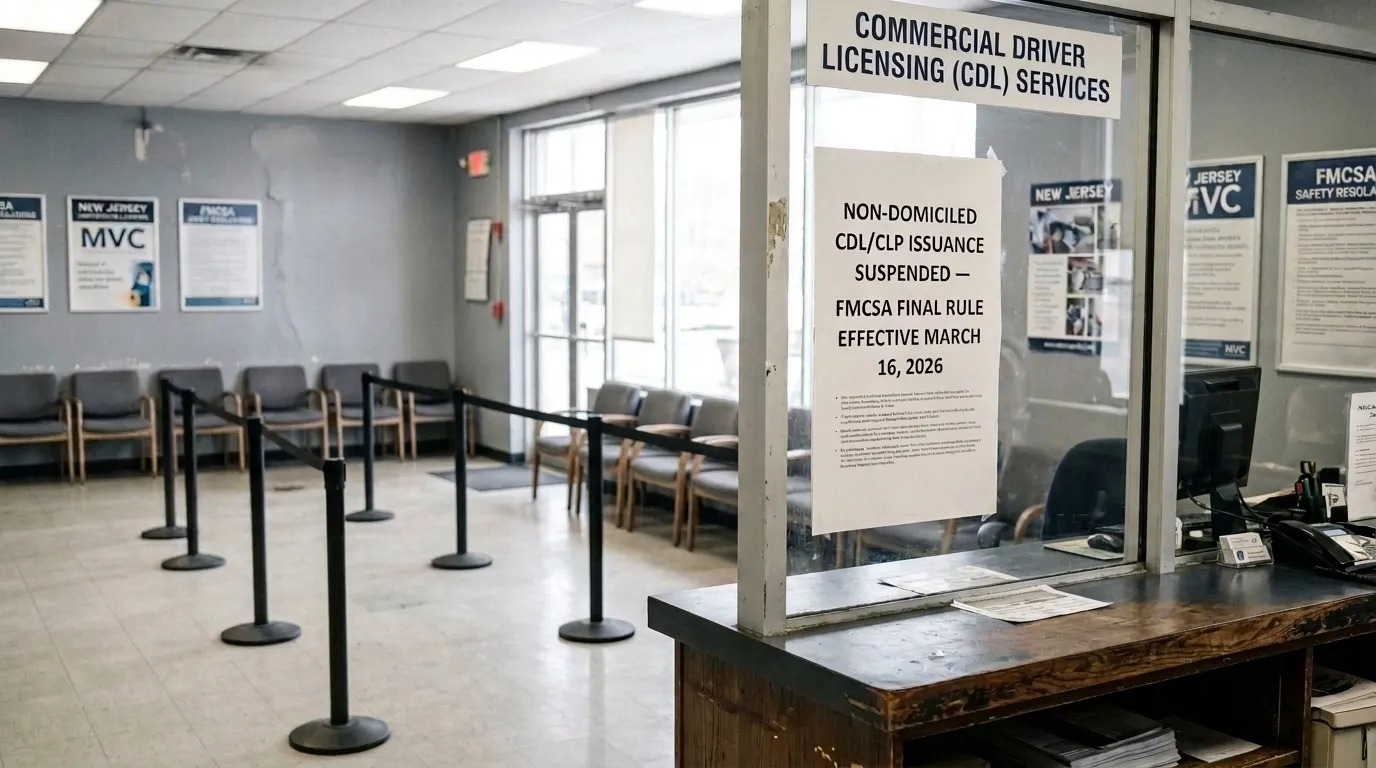
As of March 16, 2026, FMCSA enforced a final rule tightening the issuance and renewal of non-domiciled CDL and CLP for drivers without permanent residency in the state. On the same day, the agency demanded states immediately suspend issuing such documents if they cannot ensure compliance with updated federal requirements.
Public criticism of this measure emerged in New Jersey. State Senator Benjie E. Wimberly (Bergen/Passaic District) in a statement published on March 19 linked the new restrictions to job losses for immigrant drivers and disruptions in license renewals. According to the senator, about 2,000 drivers in New Jersey risk losing the ability to renew their CDL or have already faced refusals when attempting to renew. He also reported a surge of inquiries to his office—calls and letters from drivers claiming they cannot update their documents. The statement is available on the New Jersey Senate Democrats' website: Senator Wimberly's office announcement.
The FMCSA rule changes not just "procedural details" but fundamental eligibility criteria. Federal clarifications stipulate that states must verify immigration status through the SAVE (Systematic Alien Verification for Entitlements) system and issue non-domiciled CDL/CLP with limited validity: the license cannot be issued for more than one year and cannot "outlast" the legal stay date indicated on the I-94/I-94A form (Admit Until Date). FMCSA also specifies requirements for document appearance: the term "non-domiciled" must be prominently displayed on the front of the document to ensure the status is clearly readable during checks. These provisions are listed in the FMCSA implementation clarifications.
A separate issue is who retains the right to a non-domiciled CDL/CLP. Essentially, the pool of eligible applicants narrows to a limited set of immigration categories. According to the official implementation logic, states should issue or renew such documents only to those whose legal stay and right to corresponding privileges are confirmed under established criteria; others should be denied. Senator Wimberly's statement emphasizes this effect: he calls the decision a blow to residents who worked legally and are now losing renewal opportunities due to changes in federal conditions, questioning "who exactly benefits" from this rule configuration. His position is outlined in the publication: New Jersey Senate Democrats — Wimberly.
Technically, FMCSA tied the rule's launch to states' readiness to implement new checks and restrictions. In the FAQs, the agency explicitly states: if a state cannot ensure the issuance of non-domiciled CLP/CDL in accordance with updated requirements from the rule's effective date, issuance must be paused until discrepancies are resolved. This "emergency brake" triggered the driver inquiries reported by Wimberly's office. His statement describes situations where people come for renewals and are denied or face "stalled" procedures due to new federal criteria and additional checks. The source does not provide statistics on the number of denials or the share of successfully renewed licenses—an estimate of 2,000 potentially affected drivers and reports of mass complaints in districts, including Paterson and LD-35, are mentioned. These details are given in the official statement.
Stay Updated with Industry News
Subscribe to our newsletter and get the latest trucking industry news, regulations updates, and career tips delivered to your inbox.
We respect your privacy. Unsubscribe at any time.
FMCSA, for its part, links the tightening to the goal of "restoring integrity" to the non-domiciled CDL issuance process and safety. The agency's explanations emphasize that status and stay duration checks must become uniform and mandatory, and states must review previously issued non-domiciled licenses and take corrective actions if documents were issued under standards no longer allowed. In the FAQs, this is stated quite directly: an audit and compliance are required, and if not possible, issuance must be suspended until federal conditions can be met. The formulations and list of state obligations are provided in the FMCSA publication.
The New Jersey statement, on the other hand, focuses on the socio-economic aspect and local scale of consequences. Wimberly writes about risks for families and small businesses, linking the issue to communities where the share of immigrant drivers is significant. He also politically marks the decision, attributing responsibility to the federal administration and describing the situation as "deprivation" of driver's licenses for immigrant drivers. However, the statement does not provide federal norm parameters in the form of a list of visa categories or references to specific points of 49 CFR—the main text line is built around incoming complaints and the stated number of affected people. The full context and quoted formulations are available in the state Senate Democrats' website publication.
The key practical point for operators and services working with personnel is that the final rule ties the validity of non-domiciled CDL/CLP to verifiable status and legal stay durations, meaning the usual "long" validity and standard renewal cycles for some drivers are no longer possible. FMCSA specifically emphasizes the term limit (no more than a year) and the prohibition on issuing a document beyond the date indicated in I-94/I-94A, which automatically makes renewals more frequent and sensitive to any changes in immigration records. These restrictions are listed in the official FMCSA FAQs.
Senator Wimberly's statement notes that for New Jersey, the rule's implementation has already moved from a regulatory to an operational phase: people cannot complete renewals, and the legislator's office receives inquiries in real-time. The document also emphasizes that the problem, in the author's opinion, is concentrated in specific municipalities and districts, including Paterson and LD-35, and that it concerns current workers, not a hypothetical future set. These claims and the scale assessment ("about 2,000" drivers) are outlined in the official publication.