
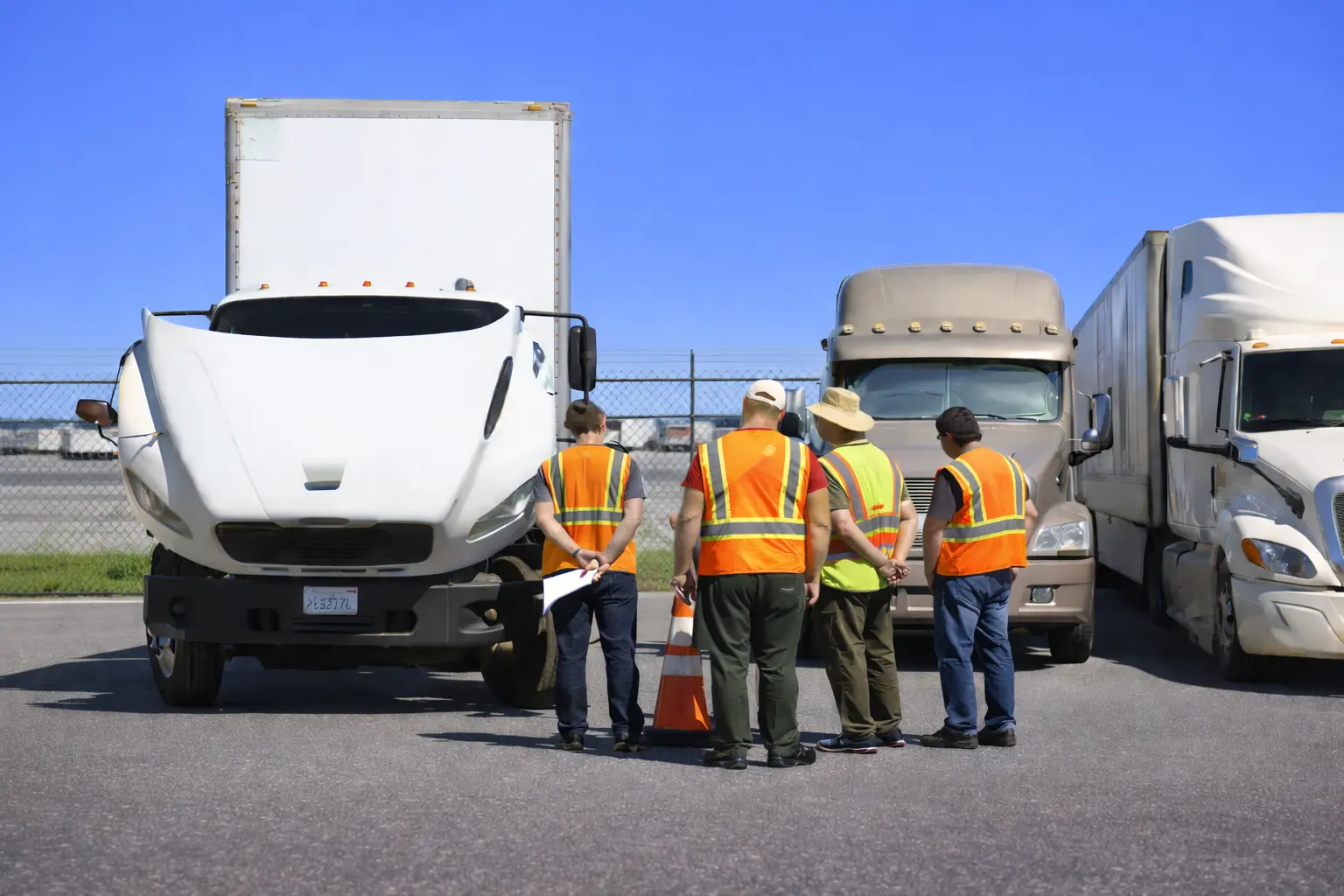
Texas Tanker CDL Practice Test
Practice for your Tanker CDL exam with questions based on the official Texas CDL handbook
Updated: August 2026
What's on the Texas Tanker CDL test
Answering from memory beats re-reading — retrieval practice roughly doubles what you remember a week later. These free questions are modeled on the official Tanker CDL knowledge test.
- Questions
- 20
- To pass
- 16/20 correct (80%)
- Updated
- June 2026
- 100% free
The Texas CDL Tanker test follows the AAMVA standard used by most states: 20 questions, with 16 correct answers (80%) needed to pass. A CDL learner's permit in Texas costs $25 (Texas Department of Public Safety (DPS) fee schedule, June 2026).
Start the practice testHauling hazmat in a tanker? That’s the X endorsement
The X endorsement is the combined tank vehicle + hazardous materials endorsement (49 CFR 383.153). To earn it you pass both knowledge tests: the tanker test — knowledge-only, no skills test (49 CFR 383.93(c)) — and the hazmat test, which additionally requires a TSA security screening (49 CFR 383.71, part 1572).
Federally, a “tank vehicle” means tanks over 119 gallons individually and 1,000+ gallons combined (49 CFR 383.5) — if that’s your rig and the load is placarded, you need the X, not just the N.
Texas HazMat practice testTexas Tanker CDL Practice Test
How do baffles in baffled tanks contribute to managing liquid movement?
- Reducing the speed of the truck
- Increasing fuel efficiency
- Controlling both forward and backward liquid surges
Baffles in tanks help stop the liquid from sloshing too much forward and backward. This makes it easier to control the truck when it's moving.
When filling up a tanker with 3 or 4 valves at its bottom, how should you position the valves?
- Locked
- Secured
- Closed
When filling up a tanker with 3 or 4 bottom valves, make sure those valves are tightly shut. This prevents any spills or leaks while loading.
When filling up and emptying tanks with bulkheads, the driver needs to ensure the weight is evenly distributed.
- TRUE
- FALSE
TRUE. When filling or emptying tanks with dividers, it's important for drivers to make sure the weight is spread out evenly. This helps keep the truck stable and safe on the road.
On all tank vehicles the most important item to check is for:
- Broken seals
- Leaks
- Cracked hoses
When checking tank vehicles, the most crucial thing to look for is leaks. This is because leaks can lead to loss of liquids, potentially causing accidents or environmental harm. Always ensure the tank is secure and leak-free to keep both you and the environment safe.
When driving, it's important to pay attention to the speed limits for curves and understand that...
- The posted speeds may not be slow enough for a tank truck
- Tank trucks have a higher center of gravity
- A rollover can still occur when traveling at posted speeds in a tank truck
- All of the above
The correct answer is "All of the above."
A tank endorsement is required for certain vehicles that transport what?
- oversize loads.
- liquids or gases.
- general freight in boxes or pallets.
Federal regulations say a tank endorsement is needed to operate a tank vehicle that requires a CDL. A tank vehicle is a commercial motor vehicle carrying bulk liquid or gas in one or more tanks that are permanently or temporarily attached to the vehicle (49 CFR 383.5; 49 CFR 383.93).
Which statement best characterizes baffled tanks?
- Baffled tanks have double walls for extra insulation.
- Baffled tanks have bulkheads with openings that let liquid flow through to other smaller tanks inside the tank shell.
- Baffled tanks are equipped with external vents to reduce internal pressure.
Baffled tanks are designed with special walls inside that have holes. These walls let liquids move through to smaller sections within the tank. This helps keep the liquid more stable and prevents it from moving around too much.
Why is it important to be aware of the required outage for the liquids you transport?
- Different liquids have the same outage requirements.
- All liquids can be safely transported without considering outage.
- For some of the heaviest liquids, you don't need to leave any clearance.
Heavier liquids expand less, so they can often be filled to the top without risking overflow. Knowing each liquid’s expansion needs helps prevent spills and ensures safe, efficient transportation.
During loading, what should be the position of the tankers' manhole covers and vent covers?
- Tightly sealed with tape
- Loosely covered with cloth
- Closed correctly.
When loading a tanker, make sure the manhole covers and vent covers are properly closed. This keeps everything safe and secure.
What do you call the walls inside a tanker that have holes at both the top and bottom?
- Barriers
- Baffles
- Surfboards
- Partitions
The correct answer is baffles. These are like walls inside a tanker truck's tank with holes on the top and bottom. They help keep the liquid from moving around too much when the truck is turning or stopping, making the drive safer.
Stop valves in a cargo tank...
- Are controlled remotely
- Close in an emergency
- Protect the tank and piping from rear end collisions
- Open automatically during maintenance
Stop valves in a cargo tank are special parts that automatically close if there's an emergency to prevent spills.
You’re driving at night with clear visibility and need to switch your headlights from high beams to low beams. You should reduce your speed so you can stop within what distance?
- the distance you could travel in the next 5 seconds.
- the distance you can see ahead.
- one car length.
At night, regardless of the type of vehicle, you must travel slowly enough to be able to stop within the area illuminated by your headlights, because you cannot anticipate hazards beyond what your lights reveal. Low beams typically light only about 250 feet ahead. For example, a vehicle with air brakes traveling 45 mph may need up to about 346 feet to stop, meaning that at 45 mph on low beams you may not be able to stop in time for something you can see.
You should inspect the intake, discharge, and cut-off valves before driving, loading, or unloading the vehicle ___.
- To confirm the valves are properly labeled.
- To verify the color of the valves.
- To ensure they are in the correct position
Before driving, loading, or unloading your vehicle, you should check the intake, discharge, and cut-off valves to make sure they are in the right position. This helps prevent any problems during your trip.
Which of these facts is correct about how to steer in an emergency when driving a tanker?
- When making a quick steering movement, do not apply the brakes
- You should only use one hand on the steering wheel during quick movements.
- Turning the steering wheel slowly is safer in emergencies.
When you need to steer quickly in a tanker, don't hit the brakes because it can lead to a skid or rollover. Quick and controlled steering is the way to prevent a crash without making things worse.
What should you inspect the tank's body or shell for?
- Leaks and discoloration
- Dents and leaks
- Cracks and rust
When inspecting a tank's body or shell, you should look for any dents and leaks. Dents can weaken the tank's structure, and leaks can cause the contents to escape, which might be dangerous or lead to waste. Checking for these issues helps ensure the tank is safe and in good condition.
A smooth bore tank is ___.
- A dry bulk cargo tank
- A tank which is portable
- A liquid tank without baffles
- A tank designed for compressed gases.
A smooth bore tank is a special kind of tank used to hold liquids. It's different because it doesn't have inside barriers, known as baffles, that usually help to keep the liquid from moving around too much.
In what situations should you exercise extra caution when driving a smooth bore tanker combination?
- When loading or unloading
- While ascending a hill
- While descending a hill
- When starting and stopping
When driving a smooth tank truck, be very careful when starting or stopping. This is because the liquid inside can move a lot, making it hard to control the truck.
Which of the following statements about tanker vehicles are true?
- Tankers can turn over at the speed limits posted for curves.
- Much of the load's weight is carried high up off the road.
- Both of the above are true.
Tank vehicles have a high center of gravity, usually about five or six feet above the ground. This makes tankers top-heavy and more likely to roll over than other vehicles. Tests show a tank vehicle can roll over even when traveling at the posted speed limit for a curve. To take a curve safely, slow to well below the posted limit.
Before loading, unloading, or driving a tanker, what precautionary steps should you take?
- Inspect the vehicle.
- Make sure your cargo is covered with a tarp.
- Check the weather forecast.
Before you do anything with a tanker, like loading, unloading, or driving it, you need to carefully check the vehicle to make sure everything is in good condition and safe to use.
Empty trucks:
- Can carry more weight than full trucks.
- May require longer stopping distances than full ones
- Are easier to control during sharp turns.
Empty trucks might take longer to stop than trucks full of stuff.
Other Texas CDL Practice Tests
Tanker Practice Tests in Nearby States
More free CDL practice tests
About the Tanker Test in Texas
The Tanker endorsement test is required in Texas for drivers who operate tank vehicles used to transport liquids or gases in bulk. It covers safe loading, unloading, surge effects, and driving techniques specific to tanker operations.
The Tanker test is part of the CDL written exam administered by the Texas Department of Public Safety. You must pass this test along with the other required written tests to receive your Commercial Learner's Permit (CLP) in Texas.
Our practice questions are built from the official Texas CDL handbook and federal FMCSA regulations. Each question includes a detailed explanation to help you understand the material, not just memorize answers.
Save your misses — the app re-asks them at the right time
Web progress isn't saved when you finish. With a subscription, the app keeps every missed question and brings it back with spaced review — and unlocks all 2,500+ questions. Free to start.

4.96,500+ ratingsacross app stores