
CDL Permit Practice Test — Study for Your CDL Exam Online
Free CDL permit practice test with 2,500+ real exam questions. Pass your CDL permit test on the first try with detailed explanations and state-specific study guides.
Free practice tests on this site. All 2,500+ questions are in the app with a subscription.
20 questions · 80% to pass · no signup
Free CDL pre-test: 20 general knowledge questions
20 questions · 80% to pass · no signup
One question at a time — the explanation shows after each answer.
All 20 questions with answers
1. What should you do when merging?
- A. Merge at a much lower speed than the flow of traffic.
- B. Use your mirrors to make sure the gap in traffic is large enough for you to enter safely.
- C. Merge without signaling.
Correct answer: B
Explanation: When you're getting onto a road, make sure there's enough room for your vehicle by checking your mirrors. You should merge into traffic smoothly without going a lot slower than other cars and always signal to let others know what you're doing.
2. Documents related to hazardous materials transportation must be stored ___.
- A. In the pouch of the driver door.
- B. Attached to the sun visor.
- C. In a box on the trailer.
Correct answer: A
Explanation: Keep the papers for hazardous materials in the driver door pouch. This way, they are easy to reach if needed.
3. Which of these statements about driving through a tunnel is correct?
- A. Keep windows open for fresh air.
- B. Turn off all lights inside the truck.
- C. There may be strong winds when exiting.
Correct answer: C
Explanation: When you drive out of a tunnel, you might feel a strong push of wind.
4. Among these vehicles, which is more likely to experience off-tracking during turns?
- A. Tractor with 45-feet trailer.
- B. 28-feet box truck
- C. 45-feet straight truck
Correct answer: A
Explanation: When a big truck turns, the back end can swing out. This is called off-tracking. A tractor with a 45-feet trailer is more likely to do this because it's longer and the way it's put together makes the back end swing out more when it turns.
5. Under what circumstances should you sound your horn?
- A. If it helps to avoid a crash.
- B. To let others know you are running late.
- C. To say hello to a friend on the sidewalk.
Correct answer: A
Explanation: Use your horn only if it can help stop an accident from happening.
6. Identify the incorrect statement regarding alcohol consumption.
- A. A drinker can control how fast his or her body absorbs alcohol.
- B. Alcohol goes directly from the stomach to the blood stream.
- C. BAC is determined by how fast you drink; how much you drink and how much you eat.
Correct answer: A
Explanation: A drinker can't control how fast his or her body absorbs alcohol.
7. If your vehicle is missing ____ or more leaves from any leaf spring, it won't be allowed to be used.
- A. 1/3
- B. 1/4
- C. 1/2
Correct answer: B
Explanation: If a quarter or more of the leaves in any leaf spring are missing, your truck can't be used until it's fixed.
8. Select the correct statement regarding the transportation of hazardous materials.
- A. Any truck carrying any amount of hazardous materials must have placards.
- B. Hazardous materials can be disposed of in regular trash bins if the containers are sealed.
- C. All hazardous materials present health and safety danger.
Correct answer: C
Explanation: Hazardous materials are always dangerous to health and safety, no matter what kind they are. They can hurt people and the environment, so it's important to handle them carefully.
9. To figure out how much alcohol is in someone's blood (BAC), you need to know:
- A. Their height.
- B. The time of day they drink alcohol
- C. Their weight.
Correct answer: C
Explanation: An individual's body weight plays a central role in determining how alcohol disperses throughout the body. Essentially, a lighter person will have a higher concentration of alcohol in their bloodstream after consuming the same amount as someone heavier.
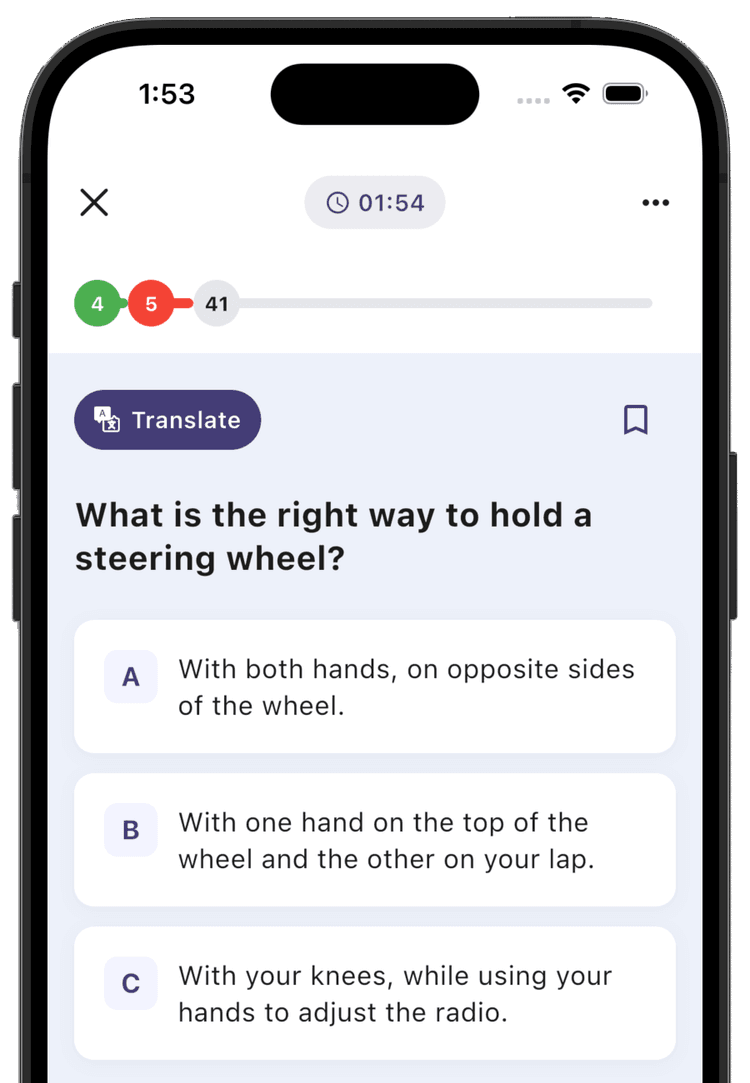
10. What is the right way to hold a steering wheel?
- A. With one hand on the top of the wheel and the other on your lap.
- B. With your knees, while using your hands to adjust the radio.
- C. With both hands, on opposite sides of the wheel.
Correct answer: C
Explanation: The correct way to hold a steering wheel is with both hands placed on opposite sides of the wheel. This gives you the most control over the vehicle, making it safer to drive.
11. What statement about the use of drugs is correct?
- A. Taking drugs is safe if driving short distances.
- B. Use of drugs can lead to an accident and/or arrest.
- C. Drugs have no effect on driving skills.
Correct answer: B
Explanation: Using drugs can make driving unsafe and might get you into an accident or even get you arrested.
12. Specify the conditions under which a driver without a hazardous materials endorsement is allowed to drive a vehicle carrying hazardous substances.
- A. The hazardous materials are contained in a tool box.
- B. The hazardous materials are in a sealed, unbreakable container.
- C. The vehicle does not require placards.
Correct answer: C
Explanation: If the hazardous materials being transported do not require placarding under federal and state regulations, a driver without a HazMat endorsement may operate the vehicle.
13. What would be your total stopping distance at 55 mph on dry pavement?
- A. The length of a football field.
- B. The width of a standard car lane
- C. Three times the height of a basketball hoop.
Correct answer: A
Explanation: If you're driving at 55 mph on a dry road and need to stop, you'll need as much space as a football field to do so safely.
14. What should you do if you see a hazard on the road ahead?
- A. Drive closely to the vehicle ahead to use it as a shield.
- B. Turn on your high beam headlights to signal danger.
- C. Use your four-way flashers or brake lights to warn others.
Correct answer: C
Explanation: When you see something dangerous on the road ahead, the best thing to do is turn on your emergency lights or tap your brakes to alert other drivers. Never get too close to the car in front as a shield, and don't just turn on your bright lights. This way, everyone can stay safe.
15. What is the safest method to merge onto the road?
- A. Wait for a large enough gap in the traffic to enter the road.
- B. Drive in reverse before merging.
- C. Use your horn to alert others before merging.
Correct answer: A
Explanation: Merging onto a road safely means finding a big enough space in traffic so you can join in without causing problems. This way, cars have room to adjust and you can blend in smoothly.
16. What statement about loading cargo is correct?
- A. A state law dictates legal weight limit.
- B. Cargo must be inspected every 100 miles.
- C. Cargo does not need to be secured if it's under 100 pounds.
Correct answer: A
Explanation: The weight limit is determined by the state in which you are operating.
17. What is the appropriate action if the drive wheels begin to spin when you start moving from a stationary position?
- A. Turn off the engine.
- B. Take your foot off the accelerator.
- C. Increase the engine's speed.
Correct answer: B
Explanation: If your wheels are tugging when you start driving, simply take your foot off the accelerator pedal.
18. What should you do when a heavy load slows you down while ascending an incline?
- A. Shift to lower gear.
- B. Turn on your hazard lights and stop.
- C. Increase your speed significantly.
Correct answer: A
Explanation: If your truck is carrying a heavy load and it's making you slow down while going uphill, you should switch to a lower gear. This helps your truck gain more power to move up the hill easier.
19. How should you arrange reflective triangles when parking on the roadside of a straight, level, four-lane divided highway?
- A. One within 5 feet of the rear of the vehicle, one about 50 feet to the rear, and one about 150 feet to the front.
- B. One within 10 feet of the front of the vehicle, one about 50 feet to the rear, and one about 250 feet to the rear.
- C. One within 10 feet of the rear of the vehicle, one about 100 feet to the rear, and one about 200 feet to the rear.
Correct answer: C
Explanation: When parking on a straight, level, four-lane divided highway, place one within 10 feet of the rear of the vehicle, one about 100 feet to the rear, and one about 200 feet behind your vehicle for safety.
20. Which of the following statements regarding the pre-trip inspection of your wheels and rims is true?
- A. Wheels do not need to be inspected if they appear clean.
- B. Rust around wheel nuts may mean that they are loose.
- C. Cracks in the wheel rims are safe as long as the wheel turns.
Correct answer: B
Explanation: Rust around the wheel nuts can be a sign that they are not tight enough. Always check this before a trip.
What’s on the CDL permit exam?
The CDL permit exam is the set of written knowledge tests you pass to get a commercial learner’s permit (CLP). The tests, the pass mark and the permit rules are federal (49 CFR Part 383); the fee, the exact number of questions and the retake rules are set by your state.
The knowledge tests
| Test | Questions | To pass | Who takes it |
|---|---|---|---|
| General Knowledge | ~50 | 40/50 (80%) | Everyone. Passing the general knowledge test is the federal precondition for a commercial learner’s permit — it covers the 20 knowledge areas every commercial driver is tested on (vehicle inspection, basic control, shifting, backing, visual search, communication, speed and space management, night and extreme-condition driving, hazard perception, emergency maneuvers, skid control, cargo and the safe-operations regulations). 49 CFR 383.71(a)(2), 383.25(a)(3), 383.111(a) |
| Air Brakes | ~25 | 20/25 (80%) | Anyone who will drive a vehicle with air brakes. If you fail the air brake portion (or skip it), your permit and license carry an air-brake restriction until you pass it. 49 CFR 383.135(a)(2), 383.95(a) |
| Combination Vehicles | ~20 | 16/20 (80%) | Class A applicants. An applicant who fails the combination vehicles portion must not be issued a Group A (Class A) permit or license. 49 CFR 383.135(a)(3) |
Question counts follow the AAMVA model most states use and vary by state — your state’s CDL manual has the exact figures. Air brakes and combination vehicles are added to the general knowledge test as extra sections; endorsements (HazMat, tanker, doubles/triples, passenger, school bus) are separate knowledge tests.
Passing score: 80%
To pass each knowledge test you must answer at least 80 percent of the questions correctly. The pass mark is federal, so it is the same in every state. On a 50-question general knowledge test that is 40 correct answers. 49 CFR 383.135(a)(1)
Commercial learner’s permit (CLP) rules
- The CDL permit test is a knowledge test, not a driving test. You get the commercial learner’s permit (CLP) by passing the written knowledge test(s); the driving skills test comes later, on the permit. 49 CFR 383.23(a)(1), 383.25(d)
- You must be at least 18 years old and prove your age to get a CLP. 49 CFR 383.71(a)(1), 383.25(a)(4)
- 14-day hold: you are not eligible to take the CDL skills (driving) test in the first 14 days after your CLP is first issued. 49 CFR 383.25(e)
- A CLP is valid for no more than one year from the date it is first issued without retaking the knowledge tests. States may issue a shorter permit and renew it within that year. 49 CFR 383.25(c), 383.73(a)(3)
- Driving on a CLP: a valid CDL holder with the right class and endorsements must be with you at all times, physically in the front seat next to you — or, in a passenger vehicle, directly behind you or in the first row behind you — with you under direct observation. 49 CFR 383.25(a)(1)
- Only three endorsements can go on a CLP — passenger (P), school bus (S) and tank vehicle (N) — each after its own knowledge test, and with restrictions (no passengers; empty tank only). HazMat and doubles/triples cannot be on a permit. 49 CFR 383.25(a)(5), 383.71(a)(8), 383.93(a)(2)
- Entry-level driver training (ELDT): since February 7, 2022, you must complete ELDT from a provider on FMCSA’s Training Provider Registry before your first Class A or Class B skills test, a first passenger or school bus skills test, or a first HazMat knowledge test. 49 CFR 383.71(a)(10)
Retakes, languages and state rules
- Every state builds its knowledge tests from the FMCSA-approved question pool (the AAMVA CDL Test System), so the material is the same nationwide. Each state sets how many questions its test forms contain — that is why question counts differ from state to state. 49 CFR 383.133(b)(1), (b)(2)(iv)
- If you fail, the state must give you a different version of the test when you retake it. How long you wait, how many attempts you get and what a retest costs are state rules — check your state page. 49 CFR 383.133(b)(4)
- Knowledge tests may be given in writing, verbally or on a computer, and may be given in a foreign language — but no interpreter may be used. The skills test is English only: you must understand and answer the examiner’s instructions in English. 49 CFR 383.133(b)(3), (c)(5)
Permit fees, question counts, waiting periods and retest limits vary by state — pick your state for the local figures and its official manual: View All States →
After the permit: the skills test
After the permit: the CDL skills test has three parts, taken in this order — pre-trip vehicle inspection, basic vehicle control, and on-road driving. If you fail one part, the test stops there. 49 CFR 383.113, 383.133(c)(6)
Official sources
- 49 CFR 383.25 — Commercial learner’s permit (CLP)
- 49 CFR 383.71 — Driver application and certification procedures
- 49 CFR 383.93 — Endorsements
- 49 CFR 383.111 — Required knowledge
- 49 CFR 383.113 — Required skills
- 49 CFR 383.123 — Requirements for a school bus endorsement
- 49 CFR 383.133 — Test methods
- 49 CFR 383.135 — Passing knowledge and skills tests
- FMCSA Training Provider Registry (ELDT)
Federal rules verified against the eCFR on 2026-09-02 (text current as of 2026-08-31). CDL Help is not a government agency.
Everything You Need to Pass
3 core CDL exams and 4 endorsement categories with thousands of practice questions
Core Tests
Endorsements
NTanker Endorsement
Safe transport of liquid and gaseous materials in tank vehicles
Knowledge test · 49 CFR 383.93(c)(3)
TDoubles and Triples Endorsement
Pulling double and triple trailers safely and legally
Knowledge test · 49 CFR 383.93(c)(1)
HHazMat Endorsement
Handling, loading, and transporting hazardous materials
Knowledge test · 49 CFR 383.93(c)(4)
PPassenger Vehicle Endorsement
Operating buses and vehicles designed to carry passengers
Knowledge + skills test · 49 CFR 383.93(c)(2)
SSchool Bus
The school bus (S) endorsement needs its own knowledge test and a skills test in a school bus, on top of the passenger (P) endorsement. CDL Help does not offer a school bus practice test yet — study the school bus section of your state’s CDL manual.
Knowledge + skills test · 49 CFR 383.93(c)(5), 383.123(a)
Practice by license class
4.95,800+ ratingsacross app stores
CDL Requirements by State
Each state has its own CDL fees, testing procedures, and requirements. Find your state to see the specifics.
Texas CDL Practice Test
Free CDL Practice Test
Florida CDL Practice Test
Free CDL Practice Test
New York CDL Practice Test
Free CDL Practice Test
California CDL Practice Test
Free CDL Practice Test
Virginia CDL Practice Test
Free CDL Practice Test
Indiana CDL Practice Test
Free CDL Practice Test
Missouri CDL Practice Test
Free CDL Practice Test
Colorado CDL Practice Test
Free CDL Practice Test
Pennsylvania CDL Practice Test
Free CDL Practice Test
Ohio CDL Practice Test
Free CDL Practice Test
Illinois CDL Practice Test
Free CDL Practice Test
Georgia CDL Practice Test
Free CDL Practice Test
What is the CDL Exam?
The CDL exam is the test you must pass to drive commercial vehicles in the United States. Every state requires it. The exam has two parts: written knowledge tests and a driving skills test.
Everyone starts with the General Knowledge written test. You may also need extra written tests for your vehicle type and endorsements. Pass all your written tests and you get a Commercial Learner's Permit (CLP). The permit lets you practice driving with a licensed CDL holder. Then you take the skills test.
You take the exam at your state DMV — the state office that issues driver's licenses. The questions follow federal rules from the FMCSA, the Federal Motor Carrier Safety Administration. Question counts, passing scores, and fees can vary a little from state to state.
How Do I Study for the CDL Exam?
1. Take Practice Tests
Test yourself with free practice questions right here on our website. This helps you identify weak areas and get comfortable with the exam format.
2. Download the App
The CDL Help app includes free practice sections — subscribe to unlock all 2,500+ questions, bookmarking, progress tracking, and study tools.
3. Focus on Weak Areas
Review questions you got wrong, read the explanations, and retake tests until you consistently score above the passing threshold (usually 80%).
4. Enroll in a CDL Truck Driving School
Once you pass the written permit exam, enroll in an accredited CDL training program to complete your behind-the-wheel training and prepare for the driving skills test.
Which CDL Class Do You Need — A, B, or C?
Class A
Required for combination vehicles with a GCWR of 26,001+ lbs when the towed vehicle is over 10,000 lbs. Includes tractor-trailers, tanker trucks, flatbeds, and livestock carriers.
Class B
Required for single vehicles with a GVWR of 26,001+ lbs, or such a vehicle towing a trailer under 10,000 lbs. Includes straight trucks, large buses, segmented buses, and box trucks.
Class C
Required for vehicles that don't fit Class A or B but are designed to transport 16+ passengers or carry hazardous materials. Includes small HazMat vehicles and passenger vans.
New English Language Proficiency Enforcement — We've Got You Covered
In 2025, federal authorities began strictly enforcing English language proficiency rules under 49 CFR §391.11. Drivers who cannot show enough English at a roadside inspection are placed out of service. Hundreds already have been.
CDL Help has included a built-in English practice feature since 2022 — long before the enforcement wave. It helps you genuinely learn the material and the language together. Road safety starts with comprehension: reading signs, answering inspectors, and communicating clearly on the job.
Stay Compliant
Meet federal ELP requirements confidently
Learn While You Study
Practice English alongside CDL material
Safer Roads
Understanding signs and instructions saves lives
Your Path to a Commercial Driver's License
To get a CDL, you must first study for and pass the permit exam at the DMV. After you receive your permit, you can take commercial vehicle driving classes and complete the required training. The final step is passing the official driving exam to earn your CDL. Our practice tests help you prepare for the DMV permit exam with real-style questions, and we also provide extra study materials and helpful resources to guide you through the process.

CDL Permit Test — Common Questions
Is the CDL permit test the same as the general knowledge test?
Yes. The written exam for a commercial learner's permit (CLP) is officially the general knowledge test, and most drivers just call it the CDL permit test. The free practice tests on this page cover the same topics as the official exam.
Can I use these as a mock CDL test before the real exam?
That is exactly what they are for. Each practice test works as a mock CDL test — a pre-test in real exam format with multiple-choice questions and explanations — so you can find weak areas before you take the actual permit exam at the DMV.
How do I start studying for the CDL permit test?
Start with the general knowledge practice test, then take your state's CDL practice test for state-specific rules. Add endorsement tests (like HazMat or air brakes) only if your job requires them.
What Drivers Are Saying
Join the drivers who prepared with CDL Help — 65,000+ downloads
“The practice tests are spot on. I used the free tests first, then downloaded the full app for all the questions. Best CDL prep tool out there.”
James T.
November 2024
“I spoke English, but could use some improvement, especially when it comes to industry terminology. The app helped me learn the material and pick up the right terms at the same time.”
Carlos M.
January 2025
“My husband used CDL Help to get his CDL and recommended it to me. The explanations after each question really help you understand the material, not just memorize answers.”
Maria L.
March 2025
Want all 2,500+ practice questions? Download the app and subscribe to unlock them all.
Download CDL Help