
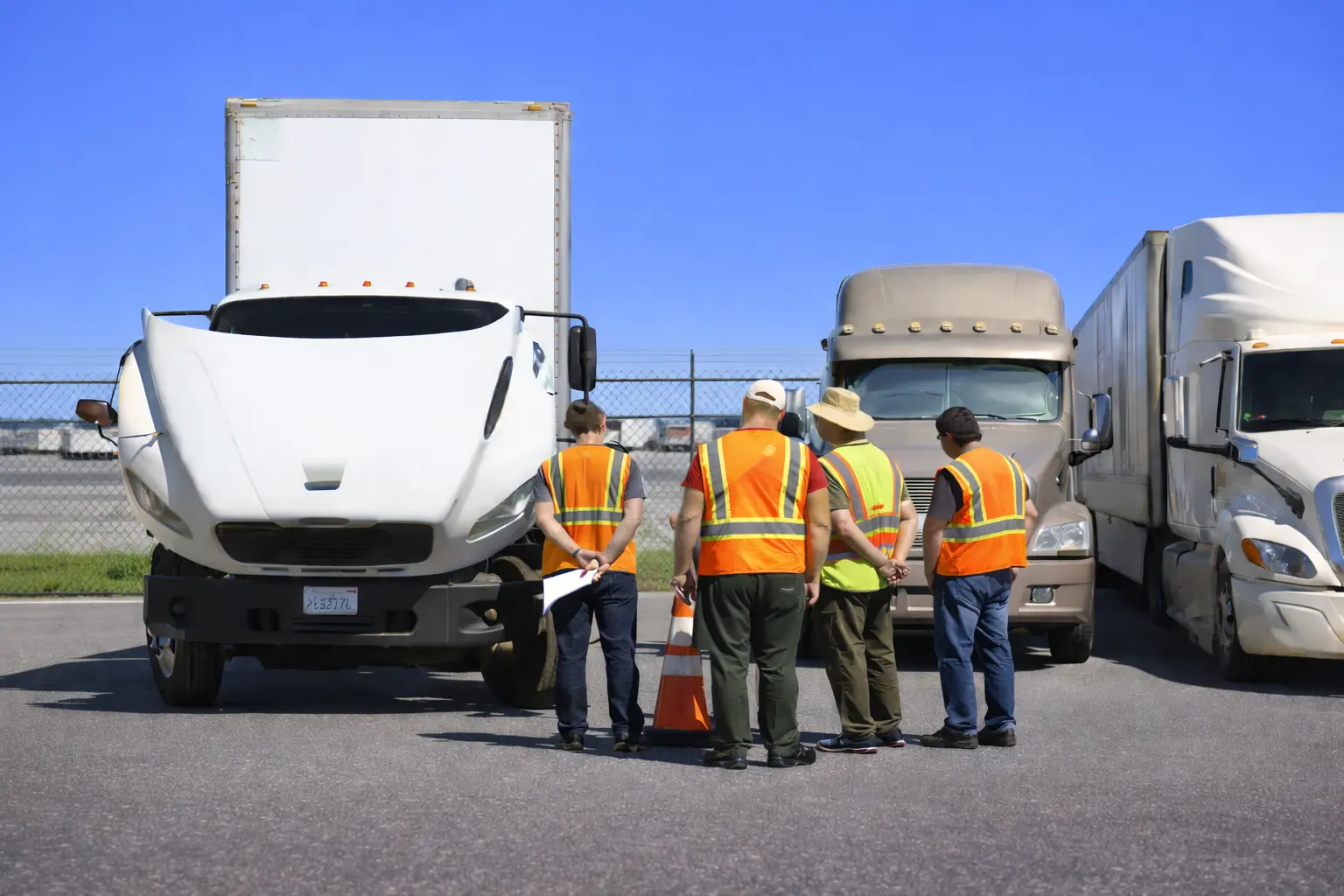
CDL training yard with trucks and students

Texas Doubles & Triples CDL Practice Test

Practice for your Doubles & Triples CDL exam with questions based on the official Texas CDL handbook

Updated: June 2026

What's on the Texas Doubles & Triples CDL test

Free practice questions modeled on the official Doubles & Triples CDL knowledge test — study now and pass the first time.

Questions
20
To pass
16/20 correct (80%)
Updated
2026
100% free

Texas Doubles & Triples CDL Practice Test

  1. To ensure proper air flow to all trailers in double and triple rigs, what should you do after applying air to the service line?

    • Go to the rear trailer, open the emergency line shut-off valve and listen for air escaping.
    • Check the tire pressure on the second trailer.
    • Disconnect the service line and observe for air pressure loss.

    To make sure air gets to the brakes on all trailers in big trucks with more than one trailer, you should turn on the air to the brakes and then go to the last trailer. Open the valve that stops emergencies and listen for air hissing out. This tells you air is reaching all the way back.

  2. When coupling a second trailer to your combination vehicle, what should you use to secure it?

    • Both answers are correct
    • The trailer's spring brakes and emergency air brakes
    • Wheel chocks

    When you are attaching a second trailer to your combination vehicle, you can use either the trailer's spring brakes and emergency air brakes or wheel chocks to secure it. Both methods are acceptable for keeping the trailer in place and ensuring safety.

  3. While driving a 100-foot twin trailer combination at 50 mph under dry road conditions and good visibility, what is the recommended minimum amount of space you should maintain ahead of you, measured in seconds?

    • 12
    • 11
    • 10

    If you're driving a big truck with two trailers at 50 mph on a dry road with clear weather, you should keep a space of at least 11 seconds ahead of you. This means you should be far enough behind the car in front of you so it takes you 11 seconds to reach where they are now. This gives you enough time to stop safely if you need to.

  4. The most effective method to prevent brakes from overheating while descending a steep grade is to ___?

    • Go 5 m.p.h. below your safe speed
    • Use stab braking
    • Use countersteering practices
    • Use only the trailer brakes

    The best way to keep your brakes from getting too hot when going down a steep hill is to go 5 miles per hour (mph) slower than the speed you feel is safe. This helps because it reduces how much you need to use your brakes, so they won't overheat as quickly.

  5. Which of the following statements regarding the converter dolly uncoupling is true?

    • Lower the landing gear before disconnecting the air lines.
    • Ensure the dolly wheels are fully inflated before uncoupling.
    • Do not unlock the pintle hook while the dolly is still under the rear trailer.

    When dealing with a converter dolly, it's important to ensure safety by following certain procedures. One crucial step is to avoid unlocking the pintle hook while the dolly is still positioned under the rear trailer. This prevents the dolly from moving unexpectedly and causing accidents or damage.

  6. In the “crack-the-whip” (rearward amplification) effect with trucks pulling multiple trailers, which unit is most likely to roll over?

    • the first (front) trailer in a triple combination.
    • the rear trailer of a triple.
    • the tractor (power unit) at the front of the combination.

    With double or triple combinations, each successive trailer is more prone to rolling over than the one ahead of it. In fact, the rear trailer of a triple is about 3.5 times more likely to roll over than a five-axle tractor-trailer. This increasing risk toward the back is called rearward amplification or the “crack-the-whip effect.” To reduce risk, put the heaviest trailer in front and the lightest in the rear.

  7. What does the term “off-tracking” mean?

    • A mechanical condition where the steering is misaligned and the vehicle pulls to one side on a straight road.
    • How the rear wheels follow a different path from the front wheels in a turn
    • When the trailer swings wide and the rear wheels follow the exact same track as the front wheels.

    Off-tracking refers to the fact that, during a turn, the front and rear wheels do not travel along the same path. The longer the vehicle, the more the rear wheels cut a different line. This means the tractor’s path is wider than the trailer/rig’s path, so you must steer wider to prevent the rig from riding over a curb or striking an object.

  8. At what air pressure range does a truck protection valve automatically close to prevent air from escaping the truck?

    • 20 PSI to 45 PSI
    • 70 PSI to 80 PSI
    • 30 PSI to 70 PSI

    A truck protection valve stops air from leaking out of the truck. It does this by closing on its own if the air pressure falls between 20 to 45 PSI. This helps keep the brakes working right.

  9. Is it true that the dolly tow bar might rise up if the pintle hook is unlocked while the converter dolly remains under the rear trailer?

    • FALSE
    • TRUE

    If you unlock the pintle hook while the converter dolly is still under the trailer, the tow bar can suddenly shoot up. This is dangerous. So, the correct answer is TRUE.

  10. What precautions should be taken when connecting the converter dolly to the rear trailer?

    • Raise the landing gear slightly off the ground
    • Make sure trailer brakes are locked
    • Make sure trailer height is correct
    • All of the above

    When hooking up the converter dolly to the back trailer, check these: 1. The trailer's brakes must be set so it doesn't move. 2. Adjust the trailer so it's at the right height. 3. Lift the support legs just a bit off the ground. You need to do all these steps.

  11. Some big trucks use convex or "spot" mirrors which:

    • Reflect light to make driving at night easier
    • Can be folded in when driving on highways to reduce wind resistance.
    • Make things look larger and closer than the really are
    • Make things look smaller and farther away than they really are

    Some big trucks have special curved mirrors. These mirrors make stuff look smaller and further away than they actually are. This helps the driver see more around the truck.

  12. When coupling twin/double trailers, if the rear trailer does not have spring brakes, ___.

    • Ensure the service line is blocked before coupling.
    • Make sure the service line is empty before coupling.
    • The emergency line should be connected and disconnected to set the emergency brakes.

    If the second trailer lacks spring brakes, position the tractor near the trailer, attach the emergency line, pressurize the trailer's air tank, and then detach the emergency line. This process will activate the trailer's emergency brakes, provided the slack adjusters are properly adjusted.

  13. You’re pulling doubles and one set of trailer wheels starts skidding. What is most likely to happen?

    • The skid will quickly correct itself and the trailers will realign without any risk of jackknifing.
    • You may jackknife.
    • The only likely result is a tire blowout on the skidding trailer.

    Use your mirrors to watch your trailers, especially after hard braking, to spot a skid early. When a trailer’s wheels begin to skid, the chance of a jackknife becomes high. If the trailer swings fully out of your lane, you may no longer be able to stop a jackknife.

  14. When coupling a set of doubles, which method can you use to secure the second trailer before you couple it?

    • Leave the second trailer unsecured and rely on the landing gear to keep it from moving.
    • Lower the dolly legs and do not use any brakes or chocks.
    • Hook up only the service line to secure the second trailer before coupling.
    • Use wheel chocks.

    If the second trailer has no spring brakes, you can pull the tractor close, connect the emergency line, charge the trailer’s air tank, then disconnect the emergency line to set the trailer’s emergency brakes (assuming the slack adjusters are properly adjusted). If you’re not sure the trailer’s brakes will hold, chock the wheels.

  15. You are operating a triple trailer, and suddenly the emergency brakes for all three trailers engage. What caused it?

    • The emergency line has lost air pressure.
    • The service brake pedal is stuck.
    • The trailers are not properly connected.

    When the emergency brakes turn on by themselves in a triple trailer, it's probably because the emergency line has lost air pressure. This line carries air to the brakes, and if the pressure drops, the brakes automatically activate to stop the trailers.

  16. The most effective method for resolving all skids is to ___.

    • Counter steer and accelerate
    • Restore traction to the tires
    • Turn off the engine.

    To stop a skid, make the tires grip the road again.

  17. To prevent which potential issue should you assess your truck protection valve?

    • The loss of air from the air hose
    • All of the above
    • The emergency brakes coming on due to loss of air
    • The loss of air from your trailer brakes

    You should check your truck protection valve to stop your emergency brakes from suddenly working if you lose air, to prevent air from escaping your air hose, and to avoid losing air in your trailer brakes. So, the correct answer is to prevent all these issues.

  18. What is the likely outcome if the pintle hook is unlocked while the converter dolly remains under the second trailer?

    • The dolly wheels might detach.
    • The dolly tow bar may fly up
    • The lights on the trailer will go out.
    • Nothing, the weight of the trailer will keep it in place

    If you unlock the pintle hook while the converter dolly is under the second trailer, the dolly tow bar may suddenly shoot upwards. This is because the pintle hook holds it in place, and removing that support without proper preparation can cause the tow bar to move unexpectedly.

  19. Which statement regarding space management when operating double or triple trailers is incorrect?

    • The trailers automatically adjust to traffic speed.
    • Double trailers can be parked in compact car spaces.
    • They do not need more space when turning or stopping.

    Double or triple trailers actually need more space when turning or stopping. These trailers are longer and more challenging to maneuver compared to a single trailer, so the statement saying they don't need more space is incorrect.

  20. A converter dolly has a ______ wheel and ______ axles.

    • fourth; one or two
    • fifth; one or two
    • third; one or two

    A semitrailer can hook to a converter dolly because, like the back of a standard tractor, the dolly includes a fifth wheel and either one or two axles.

Loading...

About the Doubles & Triples Test in Texas

The Doubles & Triples endorsement test is required in Texas for drivers who pull double or triple trailers. It covers coupling and uncoupling multiple trailers, safe driving practices, and inspection procedures for multi-trailer rigs.

The Doubles & Triples test is part of the CDL written exam administered by the Texas Department of Public Safety. You must pass this test along with the other required written tests to receive your Commercial Learner's Permit (CLP) in Texas.

Our practice questions are built from the official Texas CDL handbook and federal FMCSA regulations. Each question includes a detailed explanation to help you understand the material, not just memorize answers.