
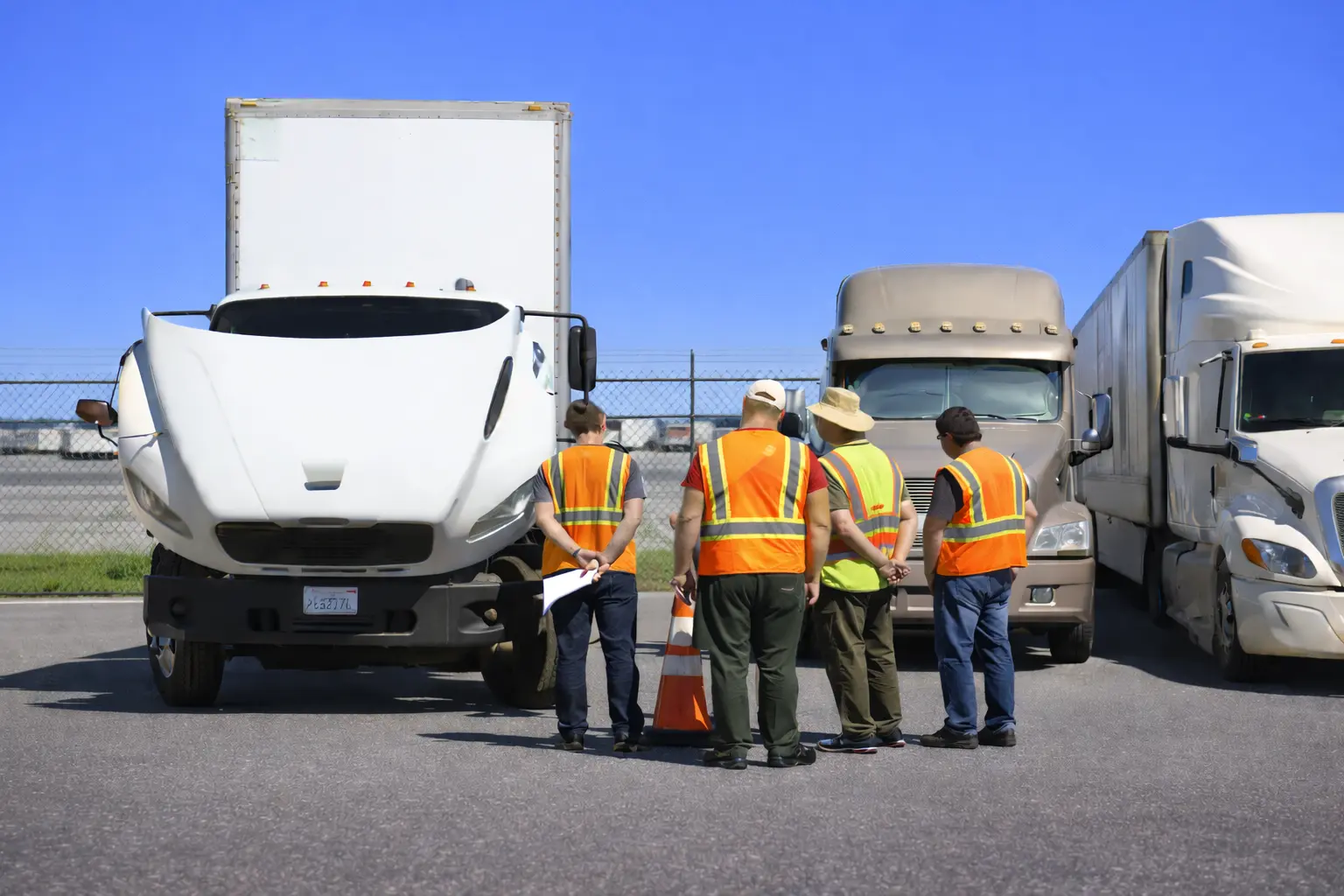
Arkansas Doubles & Triples CDL Practice Test
Practice for your Doubles & Triples CDL exam with questions based on the official Arkansas CDL handbook
Updated: August 2026
What's on the Arkansas Doubles & Triples CDL test
Answering from memory beats re-reading — retrieval practice roughly doubles what you remember a week later. These free questions are modeled on the official Doubles & Triples CDL knowledge test.
- Questions
- 20
- To pass
- 16/20 correct (80%)
- Updated
- June 2026
- 100% free
The Arkansas CDL Doubles & Triples test follows the AAMVA standard used by most states: 20 questions, with 16 correct answers (80%) needed to pass. A CDL learner's permit in Arkansas costs $0 (Arkansas Department of Finance and Administration (DFA), Office of Driver Services fee schedule, June 2026).
Start the practice testShow all 20 practice questions with answers
You have applied air to the service line on a double or triple trailer. What do you do next to check that air reaches all the trailers?
- Go to the rear trailer, open the emergency line shut-off valve and listen for air escaping.
- Disconnect the service line and observe for air pressure loss.
- Go to the front trailer, close the service line shut-off valve and watch the dash gauge.
Correct answer: Go to the rear trailer, open the emergency line shut-off valve and listen for air escaping.
Air must reach all the way to the back, or the brakes on the rear trailer will not work. Use the trailer handbrake to put air in the service line. Then walk to the rear of the last trailer and open the emergency line shut-off valve. You should hear air escaping. That sound proves the whole system is charged. If you hear nothing, check that the shut-off valves on the trailers and dollies are open. Do not disconnect the service line. That only dumps air; it does not show that air reaches the rear.
When coupling a second trailer to your combination vehicle, what should you use to secure it?
- The trailer's spring brakes and emergency air brakes
- Wheel chocks
- Both answers are correct
Correct answer: Both answers are correct
Before you back the converter dolly under the rear trailer, the trailer must be held still. Set its spring brakes if it has them. If it has no spring brakes, connect the emergency line, fill the trailer air tank, and then disconnect the line. This applies the trailer emergency brakes, provided the slack adjusters are adjusted correctly. If you are not sure the brakes will hold, put chocks at the wheels. A trailer that rolls while you work behind it can crush you or damage the dolly and landing gear. Each option alone is only part of the answer, so both are correct.
Accident reports show that trucks and buses most often run into the vehicle in front of them. What is the most frequent cause?
- Brake failure
- Following too closely
- Poor weather
Correct answer: Following too closely
You need space ahead in case you must stop suddenly, and following too closely takes that space away. A smaller vehicle ahead can probably stop faster than you can, so if you are too close you may crash into it. Doubles and triples need even more room, because they cannot be turned or stopped suddenly. Keep at least 1 second for every 10 feet of vehicle length, and add 1 second at higher speeds. The reports name following too closely as the most frequent cause, not brake failure or weather.
What is the best way to keep your brakes from overheating when you go down a long, steep downgrade?
- Use stab braking
- Use only the trailer brakes
- Keep light pressure on the brakes the whole way down
- Brake until your speed is 5 m.p.h. below your safe speed, then release
Correct answer: Brake until your speed is 5 m.p.h. below your safe speed, then release
Gravity pushes your speed up on a long, steep downgrade. Braking makes heat, and heavy use of the service brakes overheats them. Overheated brakes fade. You then press harder and harder for the same stopping power, and you may not be able to stop at all. So pick a safe speed, shift into a low gear before the grade, and let the engine hold you back. Brake just hard enough to feel a clear slowdown, and release once your speed is about 5 m.p.h. below your safe speed. Repeat that as often as you need. Leaning on the service brakes alone only adds more heat.
Which statement about uncoupling a converter dolly is true?
- Lower the dolly landing gear only after you release the pintle hook.
- Do not unlock the pintle hook while the dolly is still under the rear trailer.
- Ensure the dolly wheels are fully inflated before uncoupling.
Correct answer: Do not unlock the pintle hook while the dolly is still under the rear trailer.
Pull the dolly out from under the rear trailer before you touch the pintle hook. If you unlock the pintle hook while the dolly is still under the trailer, the dolly tow bar can fly up. It may injure you, and it makes the dolly very hard to re-couple. Then uncouple the dolly in order: lower the dolly landing gear, disconnect the safety chains, apply the converter gear spring brakes or chock the wheels, and release the pintle hook on the first semi-trailer. Tire pressure is a walk-around inspection check, not an uncoupling step.
In the "crack-the-whip" (rearward amplification) effect with trucks pulling multiple trailers, which unit is most likely to roll over?
- The rear trailer of a triple
- The tractor (power unit) at the front of the combination
- The first (front) trailer in a triple combination
Correct answer: The rear trailer of a triple
A quick lane change makes the trailers swing. This is the crack-the-whip effect, and rearward amplification causes it. The swing grows toward the back, so the final trailer of a combination has the highest risk of rolling over. Triples have a rearward amplification of 3.5. That means you can roll the last trailer of a triple 3.5 times as easily as a five-axle tractor-trailer. The tractor is the baseline for that number, so it is not the unit most at risk. Steer gently and slow down before curves and ramps. Put the heavier trailer in front and the lighter one in the rear.
What does the term "off-tracking" mean?
- The rear wheels follow a different path than the front wheels in a turn.
- The trailer swings wide and the rear wheels follow the exact same track as the front wheels.
- The steering is misaligned and the vehicle pulls to one side on a straight road.
Correct answer: The rear wheels follow a different path than the front wheels in a turn.
In a turn, your rear wheels do not follow the same path as your front wheels. That is off-tracking. The longer the vehicle, the more it off-tracks. The rear wheels of the tractor off-track some, and the rear wheels of the trailer off-track even more. With more than one trailer, the last trailer off-tracks the most. The tractor's path is therefore wider than the rig itself. So you steer the front end wide enough around the corner that the rear end does not run over the curb or hit pedestrians. Off-tracking is not a steering fault, and the rear wheels never follow the exact same track.
At what air pressure range does the tractor protection valve close by itself to keep air in the truck?
- 20 psi to 45 psi
- 50 psi to 70 psi
- 70 psi to 80 psi
Correct answer: 20 psi to 45 psi
The tractor protection valve keeps air in the truck if the trailer breaks away or starts to leak badly. The valve closes on its own once the air pressure falls to somewhere between 20 and 45 psi. When it closes, air stops flowing out of the tractor, so the truck keeps the air it needs for braking. It also releases air from the trailer emergency line, which makes the trailer emergency brakes come on. If this valve fails, a trailer leak can empty all the air from the tractor, and you can lose control. The higher ranges are wrong, because the valve is still open at 70 psi.
After you hook the converter dolly to the front trailer and lock the pintle hook, you lower the converter gear support to the ground. True or false?
- TRUE
- FALSE
Correct answer: FALSE
Once the pintle hook is locked, the dolly is hooked to the front trailer, so it no longer needs its support on the ground. The steps are: back the first semitrailer into position in front of the dolly tongue, hook the dolly to the front trailer, lock the pintle hook, and secure the converter gear support in the raised position. You lower the dolly support only when you are about to unhook the dolly from a trailer. Lowering it right after you lock the pintle hook gets the order backward.
Which precautions must you take when you connect the converter dolly to the rear trailer?
- Make sure trailer brakes are locked
- Make sure trailer height is correct
- Raise the landing gear slightly off the ground
- All of the above
Correct answer: All of the above
These three checks belong to one step, and each stops a different failure. Lock the rear trailer's brakes, or chock its wheels, so the trailer cannot roll while you back the dolly under it. Set the trailer height slightly lower than the center of the fifth wheel. The dolly then lifts the trailer a little as it slides under, which is what lets the locking jaws close on the kingpin. Raise the landing gear just clear of the ground, so it is not damaged if the trailer shifts. Each step covers a risk the other two do not, so doing only one leaves you with a trailer that can roll, a coupling that may not lock, or bent landing gear.
Before a trip, you check how your mirrors are adjusted. When can you check the adjustment accurately?
- While the rig is making a slow turn
- When the tractor is at an angle to the trailers
- When the trailers are in a straight line
- While you back the rig around a curve
Correct answer: When the trailers are in a straight line
When a rig bends at an angle, the trailers swing into or out of the mirror view. A mirror that looks right in a turn may be set wrong for straight driving. That is why mirror adjustment should be checked before the start of every trip, and it can only be checked accurately when the trailers are straight. Set each mirror to show some part of your own vehicle as a reference point. Checking during a turn, on a curve, or with the tractor at an angle gives a false picture.
Your converter dolly does NOT have spring brakes. How do you release its brakes so you can move it in front of the second trailer?
- Open the dolly's air tank petcock.
- Close the dolly's air tank petcock.
- Pull out the red trailer air supply knob.
Correct answer: Open the dolly's air tank petcock.
On a dolly with no spring brakes, the emergency brakes work from air stored in the dolly's own tank. Opening the air tank petcock lets that air out and releases the brakes. Then you can roll the dolly in front of the second (rear) trailer. A dolly that does have spring brakes is released with its own parking brake control instead. You close the petcock later, after the dolly is coupled under the rear trailer. Pulling out the trailer air supply knob does the opposite: it puts the trailer emergency brakes on.
You're pulling doubles and one set of trailer wheels starts skidding. What is most likely to happen?
- The trailer will straighten out on its own.
- Only the tractor can jackknife, not the trailer.
- You may jackknife.
Correct answer: You may jackknife.
When a trailer's wheels lock up, the trailer tends to swing around. That swing is a trailer jackknife. It happens most easily when the trailer is empty or lightly loaded. Stiff suspension springs and strong brakes give poor traction, so the wheels lock easily. Check your mirrors every time you brake hard. Seeing the trailer move out of line is your earliest warning. After the trailer has left your lane, stopping the jackknife becomes very hard. The skid does not correct itself, so act at the first sign.
Which method can you use to secure the second trailer before you couple a set of doubles?
- Lower the trailer landing gear.
- Connect only the service line.
- Use wheel chocks.
- Set the tractor parking brake.
Correct answer: Use wheel chocks.
The rear trailer must not roll while you couple it. Wheel chocks block its tires, so it stays in place as you back under it. If the second trailer has no spring brakes, another method works. Bring the tractor near it and hook up the emergency line. Fill the trailer air tank, then unhook that line. With properly adjusted slack adjusters, this applies the emergency brakes on that trailer. If you have any doubt about those brakes, use chocks. The service line alone secures nothing. It sends air to the brakes only when you use the hand brake or the brake pedal.
You are operating a triple trailer, and suddenly the emergency brakes for all three trailers engage. What caused it?
- The emergency line has lost air pressure.
- The service brake pedal is stuck.
- The trailer hand valve was released.
Correct answer: The emergency line has lost air pressure.
The emergency line has two jobs. It fills the trailer air tanks, and it controls the emergency brakes. One emergency line runs from the tractor to each trailer and dolly, so a pressure loss anywhere in it sets the emergency brakes on every trailer at once. The pressure can drop because a trailer breaks loose and tears the hose apart, or because a hose, tube or other part breaks. The same loss closes the tractor protection valve, and the air supply knob pops out. A stuck service brake pedal would apply the service brakes instead; it does not set the emergency brakes.
The most effective method for resolving all skids is to ___.
- Restore traction to the tires
- Brake harder until the wheels lock up
- Counter-steer and accelerate
Correct answer: Restore traction to the tires
A skid happens when the tires lose their grip on the road. So every skid ends the same way: you get that grip back. That one rule covers all skids. In a drive-wheel braking skid, stop braking. That lets the rear wheels roll again. Then counter-steer as the vehicle comes back on course. In a front-wheel skid, let the vehicle slow down. Never add power. Too much power to the drive wheels is itself a cause of skids, so counter-steering while you accelerate keeps the tires sliding instead of gripping. An uncorrected drive-wheel skid can push your tractor sideways into a sudden jackknife.
You check the tractor protection valve before driving. Which problem is that valve there to prevent?
- The emergency brakes coming on due to loss of air
- The loss of air from the tractor brake system
- The loss of air from your trailer brakes
- All of the above
Correct answer: The loss of air from the tractor brake system
If a trailer breaks away or has a bad air leak, air from the tractor could escape through the broken line. The tractor protection valve stops this. It holds the air inside the brake system of the tractor or truck. The valve shuts by itself when air pressure falls to about 20 to 45 psi. As it shuts, it also releases the air in the trailer emergency line. That makes the trailer emergency brakes come on. So the valve does not protect the trailer's air, and it does not prevent the emergency brakes. That is why All of the above is wrong.
You are uncoupling the rear trailer of a set of doubles. What should you do with the dolly air and electric lines before you pull the dolly out?
- Leave them connected until the dolly is clear.
- Disconnect them and let them hang loose.
- Disconnect all of them and secure them.
- Disconnect the electric line but not the air lines.
Correct answer: Disconnect all of them and secure them.
The dolly is about to move away from the rear trailer, so every line between them must be off and put away first. When you uncouple the rear trailer, disconnect all of the dolly air and electric lines and secure them. Do this before you release the dolly brakes and the dolly fifth wheel latch. Then slowly pull the tractor, first semitrailer, and dolly forward. Letting the lines hang loose skips the step of securing them, and leaving any line connected is the wrong order.
Why should you look far ahead when you pull double or triple trailers?
- So you can slow down or change lanes gradually when needed
- So you can brake hard and turn quickly at the last moment
- So you can keep a shorter following distance than other trucks
Correct answer: So you can slow down or change lanes gradually when needed
A sudden move can roll over or jackknife doubles and triples, so they must be driven very smoothly. Looking far ahead gives you early warning. Then you can slow down or change lanes gradually when you need to. These rigs are less stable than other commercial vehicles, and they cannot be turned or stopped suddenly. That is why braking hard and turning at the last moment is the wrong plan. Looking far ahead is also no reason to follow closer. With doubles and triples you must allow more following distance, not less.
A converter dolly has a ______ wheel and ______ axles.
- Fourth; three or four
- Fifth; three or four
- Fifth; one or two
Correct answer: Fifth; one or two
A converter dolly is a coupling device. It has one or two axles and a fifth wheel. The fifth wheel works the same way as a tractor's: the semitrailer's kingpin drops in and the locking jaws close on it. The dolly's other end hooks to the pintle hook on the trailer in front. That is how you add a second trailer behind the first and form a double bottom rig. A dolly has no part called a fourth wheel, so only "fifth" fits. Make a visual check of the coupling before you pull away.
All Arkansas CDL tests
The Arkansas Doubles & Triples test is one section of the Arkansas CDL knowledge exam. For the full set — general knowledge questions, every endorsement section, and Arkansas’s permit requirements in one place — go to the Arkansas CDL practice test questions.
Other Arkansas CDL Practice Tests
Doubles & Triples Practice Tests in Nearby States
More free CDL practice tests
About the Doubles & Triples Test in Arkansas
The Doubles & Triples endorsement test is required in Arkansas for drivers who pull double or triple trailers. It covers coupling and uncoupling multiple trailers, safe driving practices, and inspection procedures for multi-trailer rigs.
The Doubles & Triples test is part of the CDL written exam administered by the Arkansas Department of Motor Vehicles. You must pass this test along with the other required written tests to receive your Commercial Learner's Permit (CLP) in Arkansas.
Our practice questions are built from the official Arkansas CDL handbook and federal FMCSA regulations. Each question includes a detailed explanation to help you understand the material, not just memorize answers.
Save your misses — the app re-asks them at the right time
Web progress isn't saved when you finish. With a subscription, the app keeps every missed question and brings it back with spaced review — and unlocks all 2,500+ questions. Free to start.

4.96,500+ ratingsacross app stores