
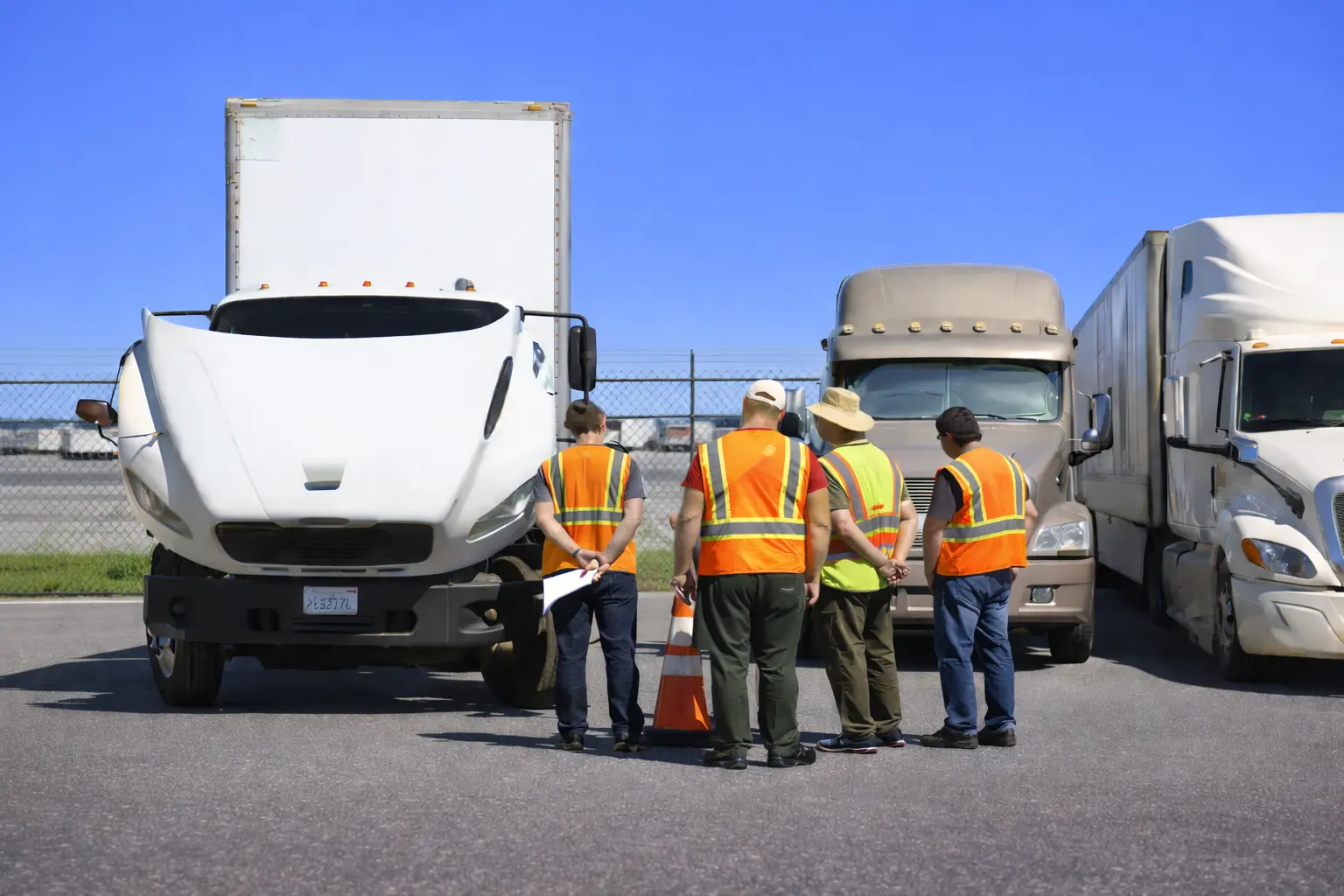
CDL training yard with trucks and students

New Mexico HazMat CDL Practice Test

Practice for your HazMat CDL exam with questions based on the official New Mexico CDL handbook

Updated: August 2026

What's on the New Mexico HazMat CDL test

Answering from memory beats re-reading — retrieval practice roughly doubles what you remember a week later. These free questions are modeled on the official HazMat CDL knowledge test.

Questions
30
To pass
24/30 correct (80%)
Updated
June 2026
100% free

The New Mexico CDL HazMat test follows the AAMVA standard used by most states: 30 questions, with 24 correct answers (80%) needed to pass. A CDL learner's permit in New Mexico costs $10 (New Mexico Motor Vehicle Division (MVD) fee schedule, June 2026).

Start the practice test

New Mexico HazMat CDL Practice Test

  1. The shippers package hazardous materials, they must certify that this was done according to the regulations. The only exception is when:

    • The driver is given a sealed cargo compartment
    • The shipper is a private carrier carrying his or her own product
    • The shipment is a hazardous waste

    When companies send out dangerous goods, they must follow rules to pack them safely. The only time they don't have to is if the company is moving its own products and not selling the service.

  2. How many hazard classes are there?

    • 3
    • 9
    • 10

    There are 9 different types of dangers or hazard classes that truck drivers need to know about when they are carrying goods. These classes help them understand what kind of special care or rules they need to follow to keep the roads safe.

  3. Apart from the shipping papers and the packages, what other two locations must display the hazardous material identification number?

    • on the front bumper and on the inside of the cab door.
    • on the exhaust system and on a decal on the dashboard.
    • on the driver’s door and on the steering column.
    • on all bulk packaging and on the cargo tanks.

    Beyond shipping papers and packages, the hazardous material identification number is also required to be shown on cargo tanks and on all bulk packaging.

  4. A driver places placards on their vehicle in order to:

    • to show the vehicle’s maximum legal weight.
    • to advertise the company hauling the load.
    • to communicate risk.
    • to indicate the driver’s route and destination.

    Placards are exterior signs on a vehicle that alert others to the presence of hazardous materials and indicate the hazard class of the load.

  5. Why is the shipper required to sign the shipping paper?

    • To confirm the carrier has inspected and approved the shipment for transport
    • To certify that it has prepared the shipment in accordance with regulations
    • To confirm the carrier has received payment for transporting the shipment

    The shipping paper has to contain the shipper’s certification, signed by the shipper, confirming the shipment was prepared in compliance with the applicable regulations.

  6. Carriers must provide each driver who hauls Division 1.1, 1.2, or 1.3 materials with:

    • a written list of emergency response phone numbers for local fire departments.
    • a copy of FMCSR Part 397.
    • a copy of the shipper’s facility address and receiving hours.

    Carriers are required to give drivers transporting explosives a copy of 49 CFR 397, “Transportation of Hazardous Materials; Driving and Parking Rules.” This part includes rules on hazardous materials routing, including factors to consider when selecting an appropriate route.

  7. Hazardous material identification numbers must be shown on portable tanks, cargo tanks, and other bulk packages. Regulations require black ______ numbers.

    • 75 mm
    • 125 mm
    • 100 mm

    Hazardous material identification numbers must appear on portable tanks, cargo tanks, and other bulk packaging. The rules specify black 100 mm (3.9 inch) numbers on orange panels, placards, or on a white diamond-shaped background when placards are not required.

  8. Helium is classified as a Class ____ hazardous material.

    • 2
    • 9
    • 1

    A hazardous material’s class indicates the type of risk it presents. There are nine hazard classes in total. Class 2 covers gases, including flammable gases (2.1) like propane, non-flammable gases (2.2) like helium, and toxic gases (2.3) such as compressed fluorine.

  9. Who must select the safest route when transporting placarded radioactive materials?

    • The state highway department
    • The receiver/consignee
    • The carrier

    If placarded radioactive materials have to be transported, the carrier is responsible for choosing the safest route. Once the route is selected, the carrier must inform the driver about the radioactive materials and provide the driver with the planned route.

  10. With most hazardous materials, you may park within 5 feet of the road briefly. If your work requires it. The materials that are the exception and do not allow parking this close to the road are?

    • Acids and poisons
    • Corrosives and oxidizers
    • Explosives 1.1 thru 1.3

    When it comes to parking near the road with hazardous materials, you usually can if it's quick and needed for work. But, don't do this with very explosive materials (like fireworks or dynamite), flammable stuff (like gasoline or propane), because it's too dangerous.

  11. A truck as hazardous material, when can it be moved without the placards on the truck?

    • Never
    • When the shipper says it's ok
    • To protect life or property

    If a truck is carrying dangerous materials, it usually must have special signs (placards) on it to show that it is hazardous. However, there is one exception to this rule. The truck can be moved without these signs only if it is necessary to protect people's lives or to prevent property from being damaged. This means safety is the top priority, and in an emergency situation, the truck can be moved even without the placards.

  12. Which option lists a required criterion for a package to qualify as non-bulk packaging?

    • A water capacity of 454 kg (1,000 pounds) or less if it is used as a receptacle for a gas
    • A maximum net mass of 400 kg (882 pounds) or less and a maximum capacity of 450 L (119 gallons) or less if it is used as a receptacle for a solid
    • A maximum capacity of 450 L (119 gallons) or less if it is used as a receptacle for a liquid
    • All of the above

    Non-bulk packaging must meet defined limits when used as a container for solids, liquids, or gases. It qualifies as non-bulk if it is: 450 L (119 gallons) or less for liquids; 400 kg (882 pounds) or less and 450 L (119 gallons) or less for solids; and 454 kg (1,000 pounds) or less for gases.

  13. If you are transporting Division 1.2 or 1.3 materials, what is the minimum distance you must park from a bridge, tunnel, or building?

    • 300 feet
    • 150 feet
    • 250 feet
    • 50 feet

    With a load of Division 1.2 or 1.3 explosives, you are required to park no closer than 300 feet from any bridge, tunnel, or other structure.

  14. Under what circumstances may a shipper shorten (abbreviate) the proper shipping name or hazardous material identification number on a shipping paper?

    • Only if regulations specifically authorize the shipper to do it
    • Only when the shipment is moving by highway within the same state
    • Only when the material is non-flammable and low hazard

    A shipper is not allowed to abbreviate a hazardous material’s identification number, hazard class, or proper shipping name unless the regulations explicitly permit that abbreviation. Abbreviations can interfere with correct identification and create safety risks.

  15. You must stop before a railroad crossing if your vehicle is transporting _______ of chlorine.

    • at least 100 gallons
    • any amount
    • more than 110 gallons

    If you are transporting any quantity of chlorine gas, you are required to stop at every railroad crossing and use extra caution before crossing. A train collision could cause a chlorine release, which is very dangerous because chlorine gas is poisonous. (If chlorine is being hauled in cargo tanks, a gas mask must be available in the cab.) Chlorine is also a strong oxidizer and can react with flammables to start fires, which may spread corrosive or toxic gases.

  16. You may allow another person to watch your vehicle only when it is…

    • parked at a public rest area while you take a break.
    • being watched by any licensed driver.
    • on the property of the shipper, carrier, or receiver.

    You may let someone else watch your vehicle only when you are on the property of the shipper, carrier, or consignee/receiver, since those parties understand the hazards and how to handle them.

  17. Which hazard class covers both flammable gases and non-flammable gases?

    • 2
    • 4
    • 9

    A material’s hazard class indicates the type of risk it presents. There are nine hazard classes. Hazard Class 2 is for gases, including flammable gases (2.1) like propane, non-flammable gases (2.2) like helium, and toxic gases (2.3) such as compressed fluorine.

  18. If you think there may be a cargo fire in your trailer and the cargo doors feel hot, what should you do?

    • crack the doors slightly to let heat and smoke escape.
    • leave the doors closed.
    • swing the doors fully open to ventilate the trailer.

    Hot cargo doors make it more likely a fire is burning inside. Opening the doors would add oxygen and can intensify the fire. Keeping the doors shut limits oxygen, so the fire may only smolder until firefighters arrive.

  19. By law, how regularly must employees involved in transporting hazardous materials be tested?

    • Within 90 days of hire and then every 3 years
    • Within 90 days of hire and then every 6 months
    • At least every 5 years

    People who transport dangerous stuff must be tested within 90 days of starting their job and then every 3 years to make sure they know how to handle these materials safely.

  20. Symbol column, the letter "G" stands for?

    • Identifies the proper shipping name for which one or more technical names of the hazardous material must be entered in parentheses, along with the basic description
    • Identifies the proper shipping name
    • Gases

    The letter "G" means you need to write the hazardous material's specific name next to its general name when shipping it.

Loading...

All New Mexico CDL tests

The New Mexico HazMat test is one section of the New Mexico CDL knowledge exam. For the full set — general knowledge questions, every endorsement section, and New Mexico’s permit requirements in one place — go to the New Mexico CDL permit practice test.

More free CDL practice tests

About the HazMat Test in New Mexico

The HazMat endorsement test is required in New Mexico for drivers who transport hazardous materials. It covers placarding, labeling, loading procedures, emergency response, and compliance with federal hazmat regulations. A TSA background check is also required.

The HazMat test is part of the CDL written exam administered by the New Mexico Department of Motor Vehicles. You must pass this test along with the other required written tests to receive your Commercial Learner's Permit (CLP) in New Mexico.

Our practice questions are built from the official New Mexico CDL handbook and federal FMCSA regulations. Each question includes a detailed explanation to help you understand the material, not just memorize answers.

New Mexico HazMat endorsement facts

New Mexico CDL facts, each with its official source
FactValueSource
Licensing agencyNew Mexico Motor Vehicle Division (MVD)mvd.newmexico.gov
CDL fee — 4-year license$18MVD publishes one CDL fee line; no separate CLP, knowledge-test or endorsement fee is statedmvd.newmexico.gov
CDL fee — 8-year license$34Not available to Hazmat-endorsement holdersmvd.newmexico.gov
Hazmat and the 8-year licenseHazmat-endorsement holders cannot choose the 8-year CDL termmvd.newmexico.gov
Minimum age — hazmat21, whether driving intrastate or interstatemvd.newmexico.gov
Passing score (knowledge and skills tests)80%realfile.tax.newmexico.gov
Wait before retaking a failed knowledge test7 daysrealfile.tax.newmexico.gov
Knowledge test attempts3 attempts per year, then a 1-year wait after the third failrealfile.tax.newmexico.gov
ELDT before testingFirst-time applicants must complete Entry-Level Driver Training with a Training Provider Registry providereffective February 7, 2022mvd.newmexico.gov
Medical certificate requiredA Commercial Driver Medical Certificate and/or any issued medical waivermvd.newmexico.gov
Who can issue the medical certificateA medical professional on the National Registry of Certified Medical Examinersmvd.newmexico.gov
Hearing standardNo medical waiver for hearing — failing the DOT hearing test blocks a commercial licensemvd.newmexico.gov
When you can take the hazmat knowledge testOnly after TSA’s threat assessment is completemvd.newmexico.gov
TSA processing target30 days from when fingerprints are submittedmvd.newmexico.gov
Hazmat application timingApply early — processing can run past the 30-day targetmvd.newmexico.gov
ELDT for a first hazmat endorsementHazmat theory training is required before the hazmat knowledge testmvd.newmexico.gov
Hazmat background check transferCannot be transferred from another statemvd.newmexico.gov
Fingerprint sitesMore than 200 fixed and mobile sites nationwidemvd.newmexico.gov
TSA security threat assessment fee (federal)$85.25Non-refundable; paid to TSA, not the stateeffective January 1, 2025tsa.gov
TSA reduced fee (valid TWIC holders, where the state accepts it)$41tsa.gov
TSA clearance validity5 yearstsa.gov
When to enroll with TSAAt least 60 days before you need the endorsementTSA says some applications take more than 45 daystsa.gov

How to add the HazMat endorsement in New Mexico

  1. If this is your first Hazardous Materials endorsement, complete the Hazmat theory portion of Entry-Level Driver Training before the hazmat knowledge test. Source
  2. Complete the TSA Hazardous Materials Endorsement application online at the Enrollment website, or by calling the Universal Enroll Help Desk at 855-DHS-UES1 (855-347-8371) — this must be finished before you arrive at a fingerprint site. Source
  3. Get fingerprinted at one of more than 200 fixed and mobile enrollment sites nationwide. Source
  4. Wait for TSA’s security threat assessment — the target is 30 days from when your fingerprints are submitted, so apply early. Source
  5. Once TSA notifies you of an approved result, take the hazmat knowledge test at an MVD office — it cannot be taken before the TSA assessment is complete. Source

As of September 2, 2026, verified against New Mexico Motor Vehicle Division (MVD).

New Mexico CDL questions

Do I need Entry-Level Driver Training before New Mexico’s CDL tests?
Yes, if you are applying for a CLP, a first-time CDL, or a school bus, passenger or hazmat endorsement for the first time on or after February 7, 2022 — you must train with a provider on the federal Training Provider Registry before the required tests. Source
Where do I get fingerprinted for a New Mexico hazmat endorsement?
Complete the TSA application online or via the Universal Enroll Help Desk (855-347-8371) first, then get fingerprinted at any of the 200+ fixed or mobile enrollment sites nationwide. Apply early — TSA’s target turnaround is 30 days, and the hazmat knowledge test cannot be taken until the assessment clears. Source
Can I transfer my hazmat background check from another state to New Mexico?
No. MVD says it cannot verify when an out-of-state background check and fingerprinting were performed, so you must complete New Mexico’s TSA enrollment process regardless of an existing endorsement elsewhere. MVD also requires renewal notice compliance within 60 days of your CDL’s expiration. Source

Save your misses — the app re-asks them at the right time

Web progress isn't saved when you finish. With a subscription, the app keeps every missed question and brings it back with spaced review — and unlocks all 2,500+ questions. Free to start.

4.95,800+ ratingsacross app stores