
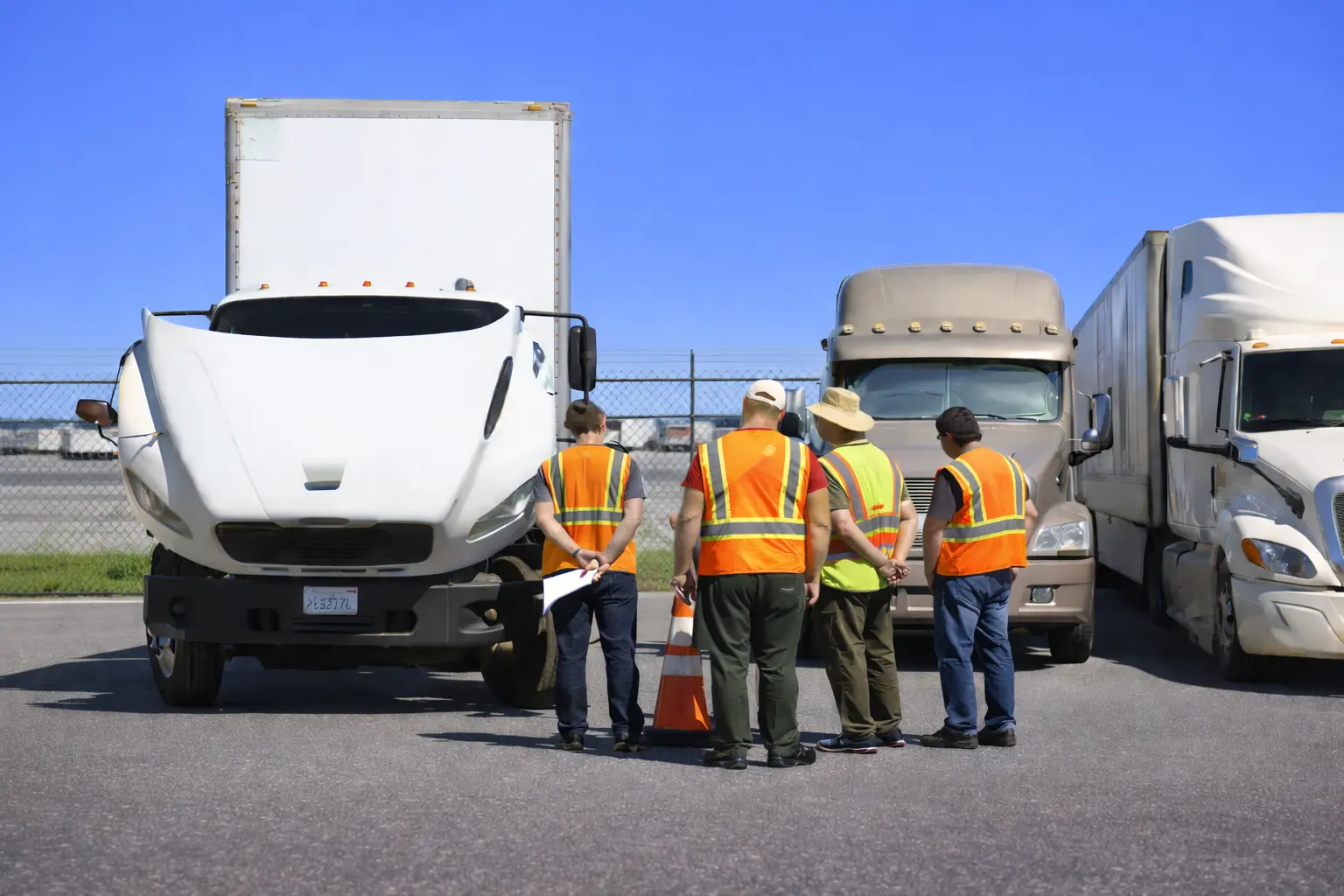
Illinois Combination Vehicles Practice Test
Practice for your Combination Vehicles CDL exam with questions based on the official Illinois CDL handbook
Updated: August 2026
The Illinois Combination Vehicles test, explained
Combination Vehicles is the knowledge test every Class A CDL applicant in Illinois takes — it is required alongside General Knowledge, not an optional endorsement, and it feeds straight into the CDL/CLP fee schedule below. (source)
An Illinois CLP or CDL costs $50 to $65 depending on class and age, and Illinois's knowledge tests need an 80% score to pass — 90% for the school bus test. (source)
What's on the Illinois Combination Vehicles CDL test
Answering from memory beats re-reading — retrieval practice roughly doubles what you remember a week later. These free questions are modeled on the official Combination Vehicles CDL knowledge test.
- Questions
- 20
- To pass
- 16/20 correct (80%)
- Updated
- June 2026
- 100% free
The Illinois CDL Combination Vehicles test follows the AAMVA standard used by most states: 20 questions, with 16 correct answers (80%) needed to pass. A CDL learner's permit in Illinois costs $50 (Illinois Secretary of State (SOS) - Driver Services fee schedule, June 2026).
Start the practice testIllinois CDL facts
| Fact | Value | Source |
|---|---|---|
| Licensing agency | Illinois Secretary of State, Driver Services — CDL Division | ilsos.gov |
| Commercial learner’s permit (CLP) — original or renewal | $50 | ilsos.gov |
| CDL — renewal or transfer in from another state | $60 | ilsos.gov |
| CDL — renewal or transfer in, age 69 and older | $50 | ilsos.gov |
| CDL renewal or transfer with a motorcycle class | $65 | ilsos.gov |
| Adding a CLP to an Illinois non-CDL licence | $50 | ilsos.gov |
| Adding or changing an endorsement or restriction (no new CLP needed) | $5 | ilsos.gov |
| CDL upgrade or correction | $5Classification change, or adding/removing an endorsement or restriction | ilsos.gov |
| Adding a School Bus Permit (SBP) | $9Illinois-only permit, on top of the CDL and S endorsement | ilsos.gov |
| Minimum age | 18 for intrastate driving; 21 to drive interstate or carry passengers | ilsos.gov |
| Base licence required for a CLP | A valid Illinois CDL or non-CDL licence, valid for the whole one-year CLP period | ilsos.gov |
| Proof of Legal Presence | Required to obtain a CLP or transfer a CDL from another state | ilsos.gov |
| Non-domiciled CLP/CDL | Illinois cannot issue one to a Mexican or Canadian citizen (49 CFR 383.23) | ilsos.gov |
| CLP validity | One year from the date of initial issuanceA further CLP means retaking all applicable tests and paying the fee again | ilsos.gov |
| Minimum CLP holding period before the skills test | 14 calendar days from the CLP issue dateA corrected CLP that adds or removes an endorsement restarts the wait | ilsos.gov |
| General (Core) Knowledge test | 30Standardized, randomly drawn multiple-choice questions | ilsos.gov |
| Passing score | 80% on each test — 90% on the school bus test | ilsos.gov |
| Test language | English only; an audio (computer-read) format may be requestedAn in-person oral test needs facility-management approval after trying the audio format | ilsos.gov |
| How long a passed knowledge test lasts | A maximum of one year | ilsos.gov |
| Waiting period after failed attempts | 30 days after 3 failures, 90 days after 6, one year after 9The wait applies only to the exam failed three times; a new fee is charged each time | ilsos.gov |
| Basic control skills exercises | Straight line backing, offset backing and parallel parking | ilsos.gov |
| Skills and drive test | Pre-Trip Inspection, Basic Control Skills, and the Driving and Road Test | ilsos.gov |
| Medical self-certification | Required of every CDL holder and CLP applicant; NI drivers must file the certificateSince June 30, 2025 the medical examiner submits the certificate electronically | ilsos.gov |
| Medical examiner’s certificate | Two years maximum, and often shorter | ilsos.gov |
| Entry-Level Driver Training | Required from an FMCSA-registered provider before a skills test can be scheduledThe provider reports completion electronically to your driving recordeffective February 7, 2022 | ilsos.gov |
| CDL term | Four years | ilsos.gov |
| Intrastate-only restriction code | K — no interstate CMV driving | ilsos.gov |
| Automatic-transmission restriction | E — placed on the CDL if you test in an automatic | ilsos.gov |
How to get a CDL in Illinois
- Check you are old enough: 18 for an Illinois CLP or CDL used intrastate only, 21 to drive interstate or to carry passengers. Source
- Hold a valid Illinois CDL or non-CDL driver’s licence as your base licence — it must stay valid for the whole one-year CLP period, so renew it first if it would expire sooner. Source
- Bring your Proof of Legal Presence documents to a Secretary of State facility and self-certify your medical category; if you certify non-excepted interstate (NI) you must also produce an acceptable medical examiner’s certificate. Source
- Pay the $50 commercial learner’s permit fee. Source
- Pass the General (Core) Knowledge written test plus the Combination (Class A), Air Brake and any endorsement knowledge tests you need. Only Tanker (N), Passenger (P) and School Bus (S) can go on a CLP. Source
- You get a temporary CLP the same day; the permanent card is mailed within 15 business days, and if the CLP was issued before your written testing finished you must wait for that card before resuming CDL tests. Source
- Complete Entry-Level Driver Training with an FMCSA-registered provider — Illinois cannot schedule your pre-trip, skills or road exam until the provider reports the completion to your driving record. Source
- Hold the CLP for at least 14 calendar days from its issue date. You may book the appointment earlier, but not for a date inside the 14-day window. Source
- Schedule the CDL skills and drive test online, or by phone on 217-785-3013 (option 3, then option 6), Monday to Friday 8 a.m. to 4:30 p.m. Source
- Bring a representative vehicle of the class and equipment you want to be licensed for, with proof of insurance, valid plates and a current safety inspection. Source
- Pass all three parts of the test — Pre-Trip Inspection, Basic Control Skills and the Driving and Road Test. Source
Official Illinois Secretary of State, Driver Services (CDL Division) links
- Illinois SOS: Commercial Driver’s License (CDL)
- Illinois SOS: CDL and CLP — requirements, fees, testing
- Illinois SOS: Driver Services fees
- Illinois SOS: Hazardous Materials Endorsement
- Illinois CDL Study Guide (PDF)
- Illinois SOS: Schedule a CDL appointment
- Illinois SOS: DMV Facility Finder
- Illinois SOS: Entry-Level Driver Training (ELDT)
- Illinois SOS: CDL FAQs
- Illinois SOS: CDL Proof of Legal Presence
As of September 2, 2026, verified against Illinois Secretary of State, Driver Services (CDL Division).
Illinois CDL questions
- How much does an Illinois CDL cost?
- The Secretary of State charges $50 for a commercial learner’s permit (original or renewal) and $60 for a CDL renewal or transfer in from another state — $50 at age 69 and over, or $65 if the licence also carries a motorcycle class. Adding or changing an endorsement or restriction is $5, and an Illinois School Bus Permit adds $9. Training-school and medical-exam costs are separate. Source
- How long is an Illinois commercial learner permit valid, and how long must I hold it?
- An original CLP expires one year from the date it was first issued, and a further one means retaking every applicable test and paying again. You must hold the CLP — temporary or permanent card — for at least 14 calendar days from its issue date before the skills and drive test; a corrected CLP that adds or removes an endorsement starts a new 14-day wait. Only the tanker (N), passenger (P) and school bus (S) endorsements can go on a CLP. Source
- How many questions is the Illinois CDL knowledge test and what score do I need?
- The computerized General (Core) Knowledge test is 30 randomly drawn multiple-choice questions. You need at least 80% on each applicable test — except the school bus test, which needs 90%. Tests are given in English only, though you may ask for an audio format in which the computer reads the test aloud. A passed knowledge test stays good for a maximum of one year. Source
- What happens if I fail an Illinois CDL test?
- Illinois runs a three-strike ladder: fail the same exam three times and you wait 30 days, three more failures (six total) means 90 days, and three more after that (nine total) means a year from the last failure. The wait applies only to the exam you failed three times, and a fee is charged again for each new round of testing. Source
- How old do you have to be to get a CDL in Illinois?
- Eighteen for an Illinois CLP or CDL — but that licence is good for intrastate driving only. You must be 21 to drive interstate or to transport passengers. Source
Other Illinois CDL Practice Tests
Combination Vehicles Practice Tests in Nearby States
More free CDL practice tests
About the Combination Vehicles Test in Illinois
The Combination Vehicles test is required for anyone seeking a Class A CDL in Illinois. It covers coupling and uncoupling procedures, rollover prevention, inspecting combination vehicles, and safely operating with attached trailers.
The Combination Vehicles test is part of the CDL written exam administered by the Illinois Secretary of State. You must pass this test along with the other required written tests to receive your Commercial Learner's Permit (CLP) in Illinois.
Our practice questions are built from the official Illinois CDL handbook and federal FMCSA regulations. Each question includes a detailed explanation to help you understand the material, not just memorize answers.
Save your misses — the app re-asks them at the right time
Web progress isn't saved when you finish. With a subscription, the app keeps every missed question and brings it back with spaced review — and unlocks all 2,500+ questions. Free to start.

4.96,500+ ratingsacross app stores