
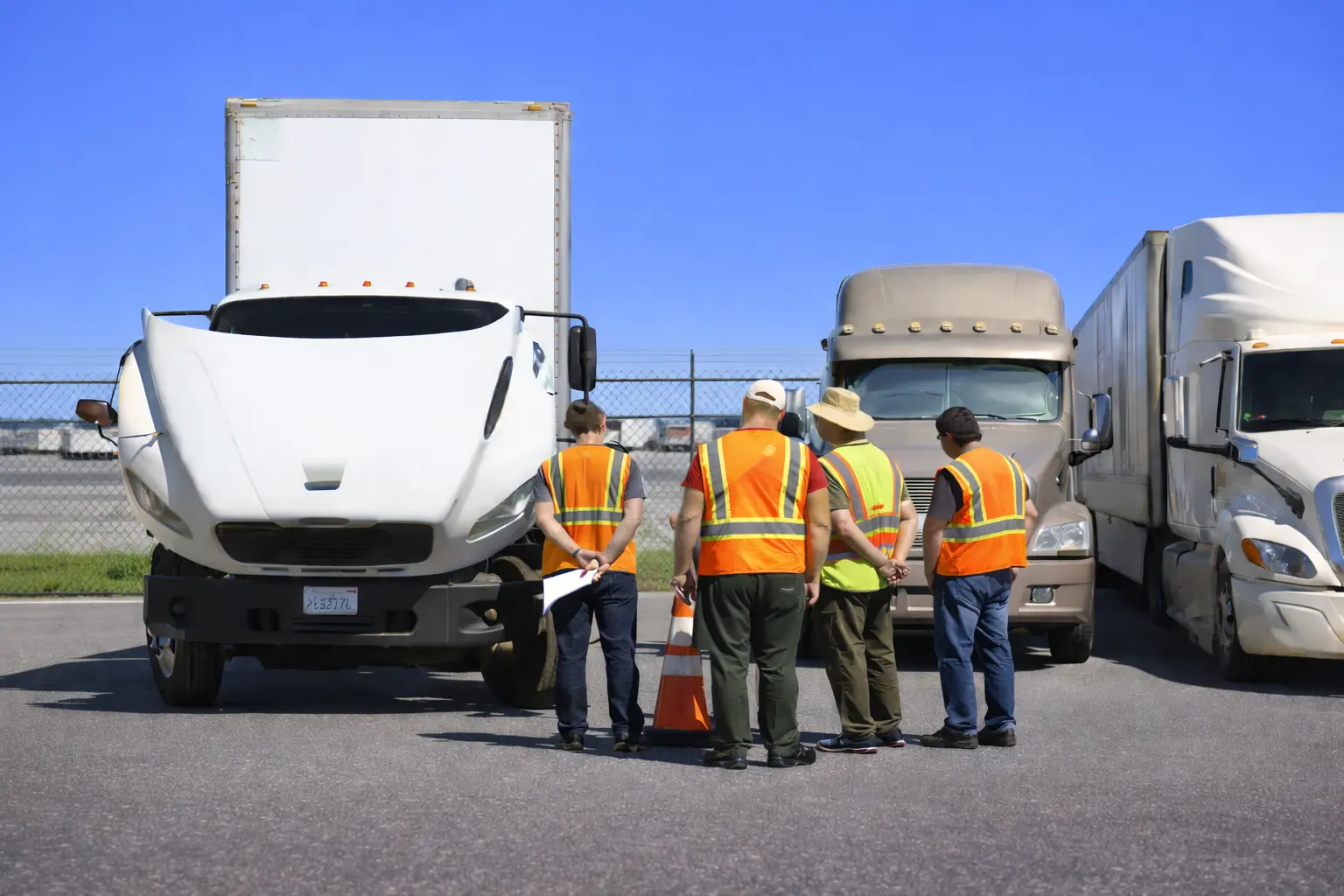
CDL training yard with trucks and students

Illinois Passenger Endorsement Practice Test

Practice for your Passenger CDL exam with questions based on the official Illinois CDL handbook

Updated: August 2026

The Illinois Passenger test, explained

Illinois's passenger (P) endorsement is not a knowledge-only add-on: after passing the written test you must hold a CLP carrying the P endorsement for at least 14 days before you can take the skills and drive test in a representative passenger vehicle. (source)

Entry-Level Driver Training has been required for a first-time P endorsement since February 7, 2022. (source)

Adding the endorsement to an existing CDL costs $5, and every applicable Illinois knowledge test needs an 80% score to pass (90% for the related school bus test). (source)

What's on the Illinois Passenger CDL test

Answering from memory beats re-reading — retrieval practice roughly doubles what you remember a week later. These free questions are modeled on the official Passenger CDL knowledge test.

Questions
20
To pass
16/20 correct (80%)
Updated
June 2026
100% free

The Illinois CDL Passenger test follows the AAMVA standard used by most states: 20 questions, with 16 correct answers (80%) needed to pass. A CDL learner's permit in Illinois costs $50 (Illinois Secretary of State (SOS) - Driver Services fee schedule, June 2026).

Start the practice test

Illinois Passenger CDL Practice Test

  1. Which statement below about a bus’s interior is NOT true?

    • It is acceptable to drive with an emergency exit door slightly open as long as it is secured.
    • A red emergency-door light may be nonfunctional as long as the door itself works.
    • Seats do not need to be securely fastened if riders can hold on to handrails.
    • If you turn on your headlights, you don't need to turn on the red emergency door light.

    If a bus has a red emergency-exit light above an emergency door, that light must be in proper working order. You are required to switch it on only when visibility is poor enough that you have turned on your headlights (for example, at night or during bad weather).

  2. Before beginning a trip, be sure to check:

    • each handhold and railing.
    • all of the above.
    • each signaling device.
    • the emergency exit handles.

    As part of your pre-trip inspection, inspect the bus interior to verify that all handholds and railings are secure, all emergency exits are accessible and properly marked, and all signaling devices are functioning correctly. This includes the restroom emergency buzzer if the bus has a restroom.

  3. When you change from high-beam headlights to low beams, what should you do?

    • maintain your speed because low beams provide the same visibility as high beams.
    • speed up to 20 mph.
    • slow down.
    • increase your speed to make up for reduced visibility.

    After dimming your high beams to low beams, reduce your speed because low beams don’t illuminate as far ahead.

  4. Which statement about looking ahead while driving is correct?

    • At highway speeds, you should keep your eyes only 1–2 seconds ahead.
    • Shift your attention back and forth, near and far.
    • Look only at the road directly in front of your vehicle and ignore distant hazards.

    When driving, look ahead about 12–15 seconds. Stay aware of what is happening around your vehicle, both near and far. Continually move your focus between near and far areas and from left to right so you are always scanning.

  5. At the end of each shift, you should:

    • Report any defects.
    • Both.
    • Inspect your bus.

    Inspect your bust at the end of each shift. Riders sometimes damage safety-related parts such as handholds, seats, and windows. If you report this damage at the end of a shift, mechanics can make repairs before the bus goes out again.

  6. In a pressurized cooling system, coolant level should be checked:

    • Only by a mechanic.
    • Every 90 days.
    • Neither

    Before starting out, make sure the engine cooling system has enough water and antifreeze according to the engine manufacturer\'s directions. Visually check level of coolant and add more coolant if necessary.

  7. Which statement below about hazardous materials is NOT true?

    • Shippers do not need to label hazardous-material packages if the material is only being shipped in small quantities.
    • All hazardous materials are allowed on buses if the driver agrees to carry them.
    • Buses are never allowed to carry small-arms ammunition, even if it is labeled "ORM-D."
    • You can carry any hazardous materials on your bus as long as they are properly labeled.

    Most hazardous materials are not allowed on buses. Some limited types (for example, small-arms ammunition marked "ORM-D") may be permitted if the packages are correctly labeled. Do not permit any hazardous material on the bus until you have confirmed the rules allow it.

  8. To reduce the risk of theft and vandalism on a charter bus, drivers should:

    • allow passengers to board early and wait on the bus.
    • do not allow riders on the bus until departure time.
    • leave the bus unlocked and unattended before departure.
    • ask passengers to store their valuables in plain view on their seats.

    To help prevent theft or vandalism, charter bus drivers should not let passengers board the bus until it is time to depart.

  9. Where on a bus is the standee line located?

    • On the floor in front of the driver’s seat
    • On the floor at the middle of the bus between the axles
    • Behind the driver's seat
    • On the ceiling above the driver’s seat

    Some buses are built to let passengers stand. They must indicate that standing is not allowed in front of the driver’s seat. One method is a standee line: a two-inch-wide line on the floor positioned just behind the driver’s seat.

  10. When should you remind passengers to take their belongings with them?

    • After passengers have already stepped off the bus
    • Only after you have left the stop and are back in traffic
    • Before you bring the bus to a complete stop

    Before the bus comes to a complete stop, remind passengers who are exiting to take their belongings. If the aisle is lower than the seats, also warn them about the step down.

  11. The interlock system for the brake and accelerator on a transit coach may be used:

    • As a safety feature when the exit door is open.
    • To replace the rear door emergency buzzer.
    • To replace the parking brake.

    Urban mass transit coaches may have a brake and accelerator interlock system. The interlock applies the brakes and holds the throttle in idle position when the rear door is open. The interlock releases when you close the rear door. Do not use this safety feature in place of the parking brake.

  12. You need to evacuate your bus in an emergency; passengers should be directed to a safe place no less than ____ feet from the bus.

    • 100
    • 75
    • 150

    Some tips to determine a safe place: A safe place will be at least 100 feet off the road in the direction of oncoming traffic.

  13. __________ must be shut while the bus is moving.

    • The windshield
    • The passenger door
    • The side mirrors
    • The emergency window

    Emergency exit windows and doors are required to be closed whenever the bus is being driven.

  14. Which seats are required to have a seat belt installed?

    • Neither of the above
    • Both of the above
    • The driver's seat
    • Side seats

    Every bus must have a properly functioning seat belt at the driver’s seat. You should wear it any time the bus is moving. In a crash, the belt helps prevent serious injury or being thrown from the seat, which could cause you to lose control of the vehicle.

  15. While operating the bus, is it allowed to have an emergency exit window open?

    • Yes, if it is latched and not swinging.
    • Yes, if a supervisor or dispatcher authorizes it.
    • Yes, as long as it’s opened for ventilation.
    • No.

    Do not drive the bus if any emergency exit door or window is open. During your interior pre-trip inspection, verify that all emergency exit doors and windows are firmly and securely closed.

  16. When you’re driving, what does the term “hazard” mean?

    • A guaranteed crash that cannot be avoided even with vigilance
    • A medical emergency that requires you to stop immediately
    • Anyone or anything that may cause an unsafe condition

    A hazard is any road user or road condition that could potentially be dangerous. It’s something that might go wrong, but shouldn’t if you stay alert.

  17. Your bus is disabled. The bus, with riders aboard, may be towed or pushed to a safe place only:

    • If getting off the bus would be riskier for the riders.
    • If the distance is less than 1 mile.
    • By another bus with its 4-way flashers on.

    Do not tow or push a disabled bus with riders aboard the vehicle, unless getting off would be unsafe. Only tow or push the bus to the nearest safe spot to discharge passengers.

  18. If your bus has an emergency exit door, it must:

    • Be secured when operating the bus.
    • both
    • Have a red electric door light turned on at all times.

    Never drive with an open emergency exit door or window.

  19. When are you required to complete a vehicle inspection report?

    • Only after the carrier reviews and approves your notes
    • At the start of the workday, before driving any vehicle
    • At the end of your shift
    • Only when you discover a defect during a pre-trip inspection

    If you drive for an interstate carrier, you must complete a post-trip vehicle inspection report for every vehicle you operated during your shift, documenting any safety-related issues found and repairs you think are needed. This informs the next driver and the carrier about needed safety repairs. Federal rules require the report to be completed by the end of that day’s use of the vehicle. As of September 2020, if you find no defects and know of none, federal regulations no longer require you to submit a report. (49 CFR 396.11)

  20. When approaching a drawbridge with no signal light or traffic control attendant, you must stop at least _______ from the bridge’s draw span.

    • 100 feet
    • 5 feet
    • 50 feet
    • 10 feet

    If a drawbridge has no signal light or traffic control attendant, you are required to stop at least 50 feet before the draw span so you can confirm the bridge is closed and safe to cross.

Loading...

Illinois Passenger endorsement facts

Illinois CDL facts, each with its official source
FactValueSource
Licensing agencyIllinois Secretary of State, Driver Services — CDL Divisionilsos.gov
Adding or changing an endorsement or restriction (no new CLP needed)$5ilsos.gov
CDL upgrade or correction$5Classification change, or adding/removing an endorsement or restrictionilsos.gov
CLP upgrade or correction$5Charged when a corrected CLP must be issuedilsos.gov
Adding a School Bus Permit (SBP)$9Illinois-only permit, on top of the CDL and S endorsementilsos.gov
Minimum age18 for intrastate driving; 21 to drive interstate or carry passengersilsos.gov
Minimum CLP holding period before the skills test14 calendar days from the CLP issue dateA corrected CLP that adds or removes an endorsement restarts the waitilsos.gov
Endorsements a CLP can carryTanker (N), Passenger (P) and School Bus (S) onlyH and X are never allowed on a CLPilsos.gov
General (Core) Knowledge test30Standardized, randomly drawn multiple-choice questionsilsos.gov
Passing score80% on each test — 90% on the school bus testilsos.gov
Test languageEnglish only; an audio (computer-read) format may be requestedAn in-person oral test needs facility-management approval after trying the audio formatilsos.gov
Waiting period after failed attempts30 days after 3 failures, 90 days after 6, one year after 9The wait applies only to the exam failed three times; a new fee is charged each timeilsos.gov
Entry-Level Driver TrainingRequired from an FMCSA-registered provider before a skills test can be scheduledThe provider reports completion electronically to your driving recordeffective February 7, 2022ilsos.gov
Passenger endorsement (P)Knowledge plus skills and drive testing; hold a CLP with P for 14 days firstELDT required since February 7, 2022ilsos.gov
Charter Bus Endorsement (C)An Illinois-only endorsement for chartered buses carrying grade-12-and-below studentsAge 21+, an Illinois-specific criminal background check and an employer-signed applicationilsos.gov

How to add the Passenger endorsement in Illinois

  1. Complete ELDT, pass the passenger knowledge test, then hold a CLP carrying the P endorsement for 14 days before the skills and drive test in a representative passenger vehicle. Source
  2. If a corrected or upgraded CLP has to be issued to carry the new endorsement, that costs $5 and starts a fresh 14-day holding period. Source
  3. Pay the $5 fee to add or change an endorsement or restriction on an existing Illinois CDL where a new CLP is not required. Source

As of September 2, 2026, verified against Illinois Secretary of State, Driver Services (CDL Division).

More free CDL practice tests

About the Passenger Test in Illinois

The Passenger endorsement test is required in Illinois for drivers operating vehicles designed to carry 16 or more passengers. It covers passenger safety, loading procedures, emergency exits, and pre-trip inspection requirements.

The Passenger test is part of the CDL written exam administered by the Illinois Secretary of State. You must pass this test along with the other required written tests to receive your Commercial Learner's Permit (CLP) in Illinois.

Our practice questions are built from the official Illinois CDL handbook and federal FMCSA regulations. Each question includes a detailed explanation to help you understand the material, not just memorize answers.

Save your misses — the app re-asks them at the right time

Web progress isn't saved when you finish. With a subscription, the app keeps every missed question and brings it back with spaced review — and unlocks all 2,500+ questions. Free to start.

4.95,800+ ratingsacross app stores