
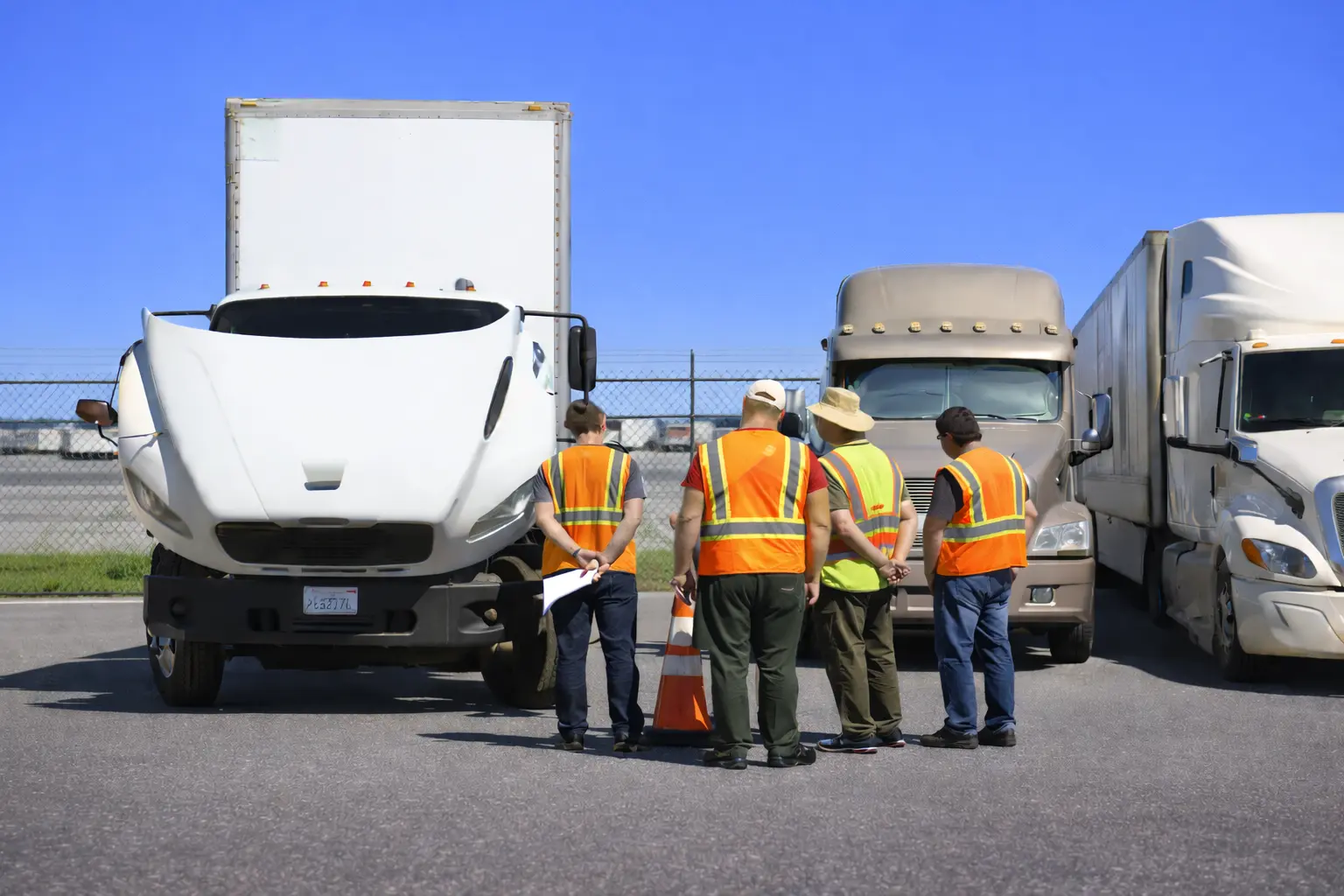
Alaska Combination Vehicles CDL Practice Test
Practice for your Combination Vehicles CDL exam with questions based on the official Alaska CDL handbook
Updated: August 2026
What's on the Alaska Combination Vehicles CDL test
Answering from memory beats re-reading — retrieval practice roughly doubles what you remember a week later. These free questions are modeled on the official Combination Vehicles CDL knowledge test.
- Questions
- 20
- To pass
- 16/20 correct (80%)
- Updated
- June 2026
- 100% free
The Alaska CDL Combination Vehicles test follows the AAMVA standard used by most states: 20 questions, with 16 correct answers (80%) needed to pass. A CDL learner's permit in Alaska costs $15 (Alaska Division of Motor Vehicles (DMV) fee schedule, June 2026).
Start the practice testShow all 20 practice questions with answers
Why should you lock the truck glad hands together, or connect them to dummy couplers, when no trailer is attached?
- It helps balance the air pressure between the tractor and trailer.
- It drains the water out of the truck's air tanks.
- It keeps dirt or water out of the lines.
Correct answer: It keeps dirt or water out of the lines.
Dirt and water can get into an open coupler and travel into the air lines behind it. Sealing the ends keeps them out. Connect the glad hands to the dummy couplers at the back of the cab. If your truck has no dummy couplers, lock the two glad hands together instead. Clean air protects your brakes. Water and oil that build up in the air system can keep the brakes from working correctly. Sealing the lines keeps that supply clean; it does not drain the air tanks or balance the air pressure.
After you couple the tractor and trailer, where must the fifth wheel safety latch be?
- Over the locking lever
- Beside the locking lever
- In front of the locking lever
Correct answer: Over the locking lever
The safety latch is a backup. The locking lever holds the fifth wheel jaws closed around the kingpin. The latch sits over that lever and keeps the locking mechanism in place if the connection starts to fail. On some fifth wheels you must put the latch in place by hand, so look at it every time you couple. A latch beside or in front of the lever holds nothing. Then the trailer can uncouple while you drive and come off the tractor at speed. If the coupling is not right, do not drive the unit; get it fixed.
What is the proper position for the fifth wheel when coupling with a trailer?
- Tilted down toward the front of the tractor
- Level and flat, with the jaws locked closed
- Tilted down toward the rear of the tractor
Correct answer: Tilted down toward the rear of the tractor
Tilt the fifth wheel down toward the rear of the tractor before you back under the trailer. Keep the jaws open and the safety unlocking handle in the automatic lock position. The low side then faces the trailer. The trailer slides up onto the greased plate, and the kingpin runs straight into the jaws. Set the trailer low enough that the tractor raises it slightly as you back under. A flat or wrongly tilted wheel can leave space between the upper and lower fifth wheel, with the kingpin resting on top of the closed jaws. The tilt runs front to back, never sideways.
After you couple the trailer to the tractor, what position should the tractor protection valve control be in?
- Emergency position
- Normal position
- Neutral position
Correct answer: Normal position
In the 'normal' position the tractor protection valve is open. Air then flows through the emergency (supply) line to the trailer. This air fills the trailer air tanks and releases the trailer spring brakes. On newer tractors, pushing in the red trailer air supply knob does the same job. After you supply air, wait for normal pressure and test the trailer brakes before you drive. The 'emergency' position is wrong here: it shuts the air off and puts on the trailer emergency brakes. With the air shut off, the trailer brakes cannot work when you need them.
Which statement about braking and stopping distance is correct?
- A lightly loaded rig gets better traction, so its wheels are hard to lock up.
- Braking efficiency increases as vehicle weight decreases.
- Bobtail tractors can take longer to stop than a combination vehicle loaded to maximum gross weight.
Correct answer: Bobtail tractors can take longer to stop than a combination vehicle loaded to maximum gross weight.
A tractor's brakes and springs are designed to carry the weight of a loaded trailer. Without that weight, the stiff suspension springs and powerful brakes cannot grip the road well, and the wheels lock up very easily. So a bobtail tractor is hard to bring to a smooth stop. It can need more distance to stop than a tractor-semitrailer at maximum gross weight. Locked wheels can make the tractor jackknife, or make the trailer swing out and hit other vehicles. Full or empty, control your speed, keep a large following distance, and brake early. Less weight does not give you a shorter stop.
After you unlock the fifth wheel and pull the tractor forward, where should the tractor be while you inspect the landing gear?
- With the tractor frame under the trailer
- Next to the trailer, but not aligned with it
- Parked at a 45-degree angle to the trailer
Correct answer: With the tractor frame under the trailer
Pull the tractor forward only until the fifth wheel clears the trailer. Then stop, with the tractor frame still under the trailer. The frame acts as a backstop: if the landing gear collapses or sinks, the trailer drops onto the frame instead of onto the ground. Set the parking brake, then check that the ground supports the trailer and that the landing gear is not damaged. Parking beside the trailer takes that backstop away. Pulling out at an angle can bend the landing gear, so keep the tractor lined up with the trailer.
After coupling a tractor to a semitrailer, you check the connection. What should you see?
- A small gap between the trailer apron and the fifth wheel
- No gap between the trailer apron and the fifth wheel
- Locking jaws that are open behind the kingpin
Correct answer: No gap between the trailer apron and the fifth wheel
A gap means the trailer is not sitting flat on the fifth wheel, so the coupling may not be secure. The trailer must lie flat on the fifth wheel skid plate. There must be no space between the apron and the fifth wheel. The locking jaws must be closed on the kingpin, not open. A bad connection can cause handling problems, a rollover, or the tractor and trailer separating. Even a small gap fails this check, so fix the coupling before you drive.
You are driving a combination vehicle. The trailer breaks away, and both air lines separate. The trailer brakes come on. What else should you expect?
- The tractor to lose all of its air pressure
- The tractor protection valve to close
- The trailer air tanks to keep filling with air
Correct answer: The tractor protection valve to close
Both air lines part, so the emergency (supply) line loses all its pressure. That one pressure loss does two things. It sets the trailer emergency brakes, and it closes the tractor protection valve. The red trailer air supply knob pops out when the valve closes. The closed valve stops air from going out of the tractor, so you keep enough air to brake the tractor and stop safely. The valve also closes on its own when pressure drops to 20 to 45 psi. No air reaches the trailer after the lines part, so its air tanks cannot keep filling.
You are getting ready to back your tractor under a semitrailer. How do you know the trailer is at the correct height?
- The kingpin locks into place without any adjustment needed.
- The trailer sits a little higher than the center of the fifth wheel.
- The trailer will be lifted slightly when the tractor backs under it.
Correct answer: The trailer will be lifted slightly when the tractor backs under it.
Before you back under, set the trailer slightly lower than the center of the fifth wheel. The trailer nose then rides up and lifts a little as the tractor moves under it. That small lift is the sign the height is right, because it means the kingpin is entering the locking jaws. Set the trailer too high and the fifth wheel can slide under the kingpin without locking. Set it too low and the tractor strikes the trailer nose and landing gear. Waiting for the kingpin to lock is too late: you check the height before you back, not after.
A higher center of gravity makes your truck:
- Harder to stop with the brakes
- Harder to accelerate
- Easier to turn over
Correct answer: Easier to turn over
A high center of gravity means much of the load's weight rides high off the road. That makes the truck top-heavy and easy to roll over, and rollovers happen when you turn too fast. More than half of truck driver deaths in crashes come from rollovers. A fully loaded rig is ten times more likely to roll over than an empty one. Keep cargo as close to the ground as possible, keep it centered, and drive slowly around corners, on ramps and off ramps. Load height changes how easily the truck tips, not how your brakes or your engine work.
Why is it necessary to put grease on the fifth wheel plate?
- To improve fuel efficiency
- To prevent steering problems
- To hold the trailer kingpin in place
Correct answer: To prevent steering problems
The fifth wheel plate carries the trailer's weight, and the trailer apron turns against that plate every time you steer. Grease lets the two steel surfaces slide. Without it, friction between the tractor and trailer binds the coupling, so steering gets hard and rough. Hard steering slows every correction you make, and that costs you control of the rig. So check that the fifth wheel plate is greased as required before you couple. Grease does not hold the kingpin in place; the locking jaws do that. Saving fuel is not the reason you do it either.
When uncoupling the trailer, after you turn off the trailer air supply and make sure the trailer's brakes are set, you should:
- Raise the landing gear all the way up.
- Back up gently to ease pressure on the fifth wheel.
- Push the trailer air supply knob in to release the trailer brakes.
Correct answer: Back up gently to ease pressure on the fifth wheel.
Backing up gently pushes the tractor against the kingpin. That eases the load off the fifth wheel locking jaws, so the release lever pulls freely instead of binding. Set the tractor parking brakes while it is still pushing against the kingpin. That holds the pressure off the jaws. Only then do you chock the trailer wheels, lower the landing gear, and unlock the fifth wheel. Raising the landing gear gets the order backward, since you lower it later, and pushing in the trailer air supply knob would release the trailer brakes you just set.
A truck pulling a _______ trailer needs the longest distance to stop.
- Heavy
- Empty
- Evenly loaded
Correct answer: Empty
An empty trailer runs light, so the very stiff suspension springs and strong brakes give poor traction. The wheels lock up easily, and locked wheels skid instead of slowing the rig. That is why an empty truck takes longer to stop than a loaded one. A skid can swing the trailer out into other vehicles, and the tractor can jackknife very quickly. Control your speed and brake early whether you run loaded or empty. Heavy feels like the right answer, but a loaded trailer keeps better traction and stops in a shorter distance.
When you follow another vehicle at speeds below 40 mph, allow at least one second of space for every ____ feet of your vehicle's length.
- 30
- 20
- 10
Correct answer: 10
Your following distance must match your vehicle's length. A long, heavy rig needs far more room to stop than the car ahead of it. So count one second for every 10 feet of length at speeds below 40 mph, and add one more second above 40 mph. A 40-foot truck needs 4 seconds; a 60-foot rig needs 6. Trucks most often run into the vehicle in front, and the usual cause is following too closely. One second per 20 or 30 feet would leave that 60-foot rig only 3 or 2 seconds — far too little room to stop.
When driving a truck with two trailers, which shut-off valve do you have to close on the last trailer?
- Back valve
- Relay valve
- Front valve
Correct answer: Back valve
Any trailer that can pull another trailer has shut-off valves at its back, one in the service line and one in the supply line. The last trailer has nothing behind it, so you close both of its back valves. If they stay open, air escapes out the back. The service line then cannot hold the pressure that applies the trailer brakes. The supply line also loses air, and that loss sets the trailer emergency brakes, so you can lose control. Keep every other shut-off valve open. Air has to reach the rear of the rig, or some brakes will not work. A trailer has no shut-off valve at its front.
You are testing a tractor pulling one trailer. Both units have air brakes. With the engine off and the foot brake held down, the air pressure must not drop more than _____ psi in one minute.
- 2
- 3
- 4
Correct answer: 4
A combination vehicle adds trailer air lines, couplings and brake chambers to the system. The allowed leak is therefore a little larger. Shut the engine off, release the parking brake and the tractor protection valve, then hold the foot brake down. After the gauge settles, the pressure must not fall more than 4 psi in one minute. 3 psi is the limit for a single vehicle, so it is the tempting wrong pick. A faster leak means a bad seal or line. The air can run out on the road, the emergency brakes come on, and the stop is abrupt and uncontrolled.
Trailers with air brakes that were built before 1975:
- Usually need a glad hand converter.
- Are not required to have spring brakes.
- Have a parking brake instead of spring brakes.
Correct answer: Are not required to have spring brakes.
Trailers built before 1975, and converter dollies, do not have to carry spring brakes. They use emergency brakes instead, which work from the air stored in the trailer air tank. Those brakes come on when the emergency line loses pressure. But they hold only while air remains in the tank. The air leaks away in time, and then the trailer has no brakes. These trailers also have no parking brake, so chock the wheels every time you park one.
A tractor-trailer has air brakes on both the tractor and the trailer. The engine is off, the parking brake is released, and you are not pressing the foot brake. In one minute, the air pressure should not drop more than ____ psi.
- 4
- 3
- 2
Correct answer: 3
Air can leak from the system even when the truck is parked. The static test finds those leaks. You charge the system, shut off the engine, release the parking brake, and keep your foot off the brake pedal. Then you watch the gauge for one minute. On a tractor and trailer that both have air brakes, the pressure may drop no more than 3 psi in that minute. A faster drop means a leak. A leaking system loses air while you drive, and the spring brakes can come on by themselves. 2 psi is the limit for a single vehicle, not for a combination. 4 psi applies to the other test, where you hold the foot brake down.
Your trailer starts to skid. What should you do?
- Apply the brakes
- Release the brakes
- Tap the brakes lightly
Correct answer: Release the brakes
A trailer skids when its wheels lock and stop rolling. Locked wheels have much less grip than rolling wheels. The trailer then slides sideways and can push the tractor into a jackknife. Release the brakes as soon as the trailer starts to skid or swing out. The wheels roll again, grip returns, and you can steer the trailer back in line. Countersteer and stay off the brakes until you have control. Braking harder, or holding light pressure on the pedal, keeps the wheels locked and makes the skid worse.
Two things help prevent a truck rollover. One is to keep the load as low as possible. What is the other one?
- Drive slowly around turns.
- Load the heaviest cargo on top.
- Keep both hands firmly on the steering wheel.
Correct answer: Drive slowly around turns.
Slowing down in turns is the other half of rollover prevention. A truck rolls over when it takes a turn too fast. So reduce speed before corners and on entrance and exit ramps. High cargo raises the truck's center of gravity, and that makes the rig tip over more easily. A low, centered load keeps the weight down. In a crash, a fully loaded rig is ten times as likely to roll as an empty one. Rollovers also cause more than half of truck driver deaths. A firm two-handed grip helps you steer, but it cannot stop a high load from tipping the trailer in a fast turn.
Other Alaska CDL Practice Tests
Combination Vehicles Practice Tests in Nearby States
More free CDL practice tests
About the Combination Vehicles Test in Alaska
The Combination Vehicles test is required for anyone seeking a Class A CDL in Alaska. It covers coupling and uncoupling procedures, rollover prevention, inspecting combination vehicles, and safely operating with attached trailers.
The Combination Vehicles test is part of the CDL written exam administered by the Alaska Department of Motor Vehicles. You must pass this test along with the other required written tests to receive your Commercial Learner's Permit (CLP) in Alaska.
Our practice questions are built from the official Alaska CDL handbook and federal FMCSA regulations. Each question includes a detailed explanation to help you understand the material, not just memorize answers.
Save your misses — the app re-asks them at the right time
Web progress isn't saved when you finish. With a subscription, the app keeps every missed question and brings it back with spaced review — and unlocks all 2,500+ questions. Free to start.

4.96,500+ ratingsacross app stores